
Isotope analysis of OSIRIS-REx samples reveals Bennu formed near the water-ice line, not in the outer solar system
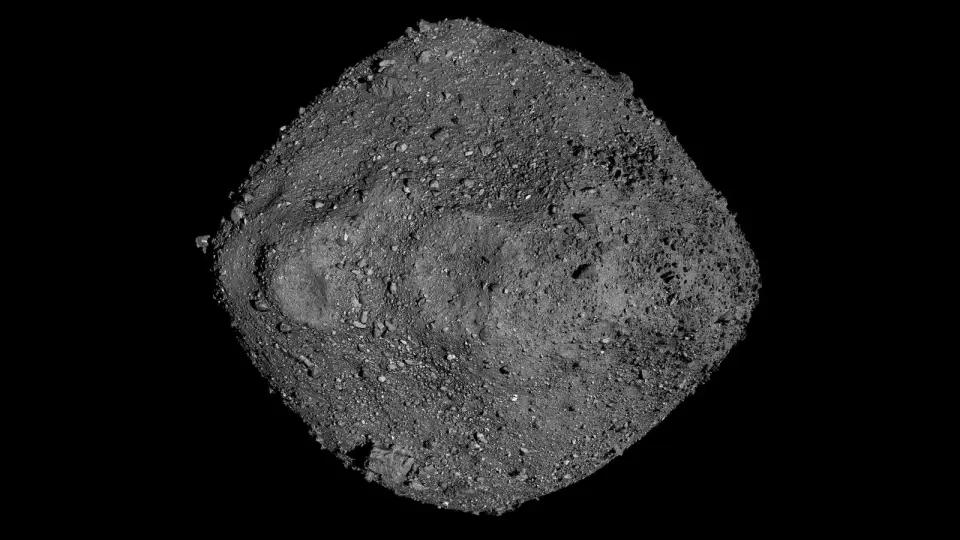
New analysis of 120 grams of regolith returned from asteroid Bennu by NASA’s OSIRIS-REx mission suggests the body formed in a transition zone near the water-ice line, rather than the distant outer solar system. Researchers at ETH Zurich and Lawrence Livermore National Laboratory found that iron and titanium isotopes in the samples are remarkably consistent, linking Bennu to a mixed dust reservoir shaped by early Jupiter. This finding challenges previous assumptions that Bennu originated in the same region as comets, proposing instead that it accreted fine dust from both inner and outer solar system regions, filtered by Jupiter’s gravitational influence.
Key points
- NASA’s OSIRIS-REx mission delivered 120 grams of Bennu regolith to Earth in September 2023; ETH Zurich received 0.5 grams for isotope analysis.
- Analysis of iron, titanium, and chromium isotopes shows Bennu’s composition is a hybrid, matching neither purely inner nor outer solar system material.
- Iron and titanium signatures were nearly identical across five samples, while chromium showed minor variations linked to water alteration.
- Researchers propose Jupiter acted as a size-selective filter, blocking large rocks but allowing fine dust from across the solar system to mix in a zone near the water-ice line.
- The study suggests Bennu’s parent body formed approximately 2 million years after the solar system’s earliest solids, earlier than many comet-forming models predict.
Background
This analysis builds on the successful return of samples from asteroid Bennu, a near-Earth asteroid visited by OSIRIS-REx between 2018 and 2021. Previous assumptions placed Bennu’s origin in the outer solar system, similar to comets. The new findings provide a more nuanced view of early solar system dynamics, complementing broader efforts to understand planetary formation, such as China’s upcoming Mars sample return mission and NASA’s ongoing exploration of small bodies.
How outlets are covering it
Space.com and swissinfo.ch emphasize the shift from the 'outer solar system' hypothesis to a 'water-ice line' origin, highlighting the role of Jupiter in filtering dust. StudyFinds and The Brighter Side of News focus on the isotope consistency across samples and the 'hybrid' nature of Bennu’s composition. While all sources agree on the Jupiter-filtering mechanism, StudyFinds notes that the explanation remains a leading hypothesis rather than a settled fact, with some chromium variations still unexplained. The Brighter Side of News underscores the implication for understanding how water and organic materials reached inner planets.
Why it matters
Understanding the origin of carbonaceous asteroids like Bennu is crucial for reconstructing the early solar system’s chemical evolution. If Bennu formed in a mixed dust reservoir near the water-ice line, it suggests that volatile-rich materials, including water and organic molecules, could have been transported to inner planets more efficiently than previously thought. This has implications for the origin of life on Earth and the distribution of resources in the solar system.
What to watch
Researchers will continue to analyze the remaining Bennu samples to resolve the unexplained chromium variations and confirm the formation timeline. Future missions, such as Japan’s MMX mission to Phobos and Deimos, may provide additional data on asteroid formation processes. The findings will also inform models of protoplanetary disk dynamics and the role of giant planets in shaping small body populations.
- Asteroid samples from NASA's epic OSIRIS-REx mission show Bennu was born from fire and ice Space
- Jupiter May Be the Reason This Asteroid’s Dust Looks Like The Sun StudyFinds
- Swiss researchers unravel origins of asteroid Bennu swissinfo.ch
- Asteroid Bennu may have formed much closer to the Sun than scientists thought The Brighter Side of News
- Asteroid Bennu Formed From A Mixture Of Inner And Outer Solar System Material Potentially Stirred Up By Jupiter IFLScience
Want the full story? Read the original reporting
Read on Space