
Johns Hopkins Study Links JWST 'Little Red Dots' to Primordial Black Holes
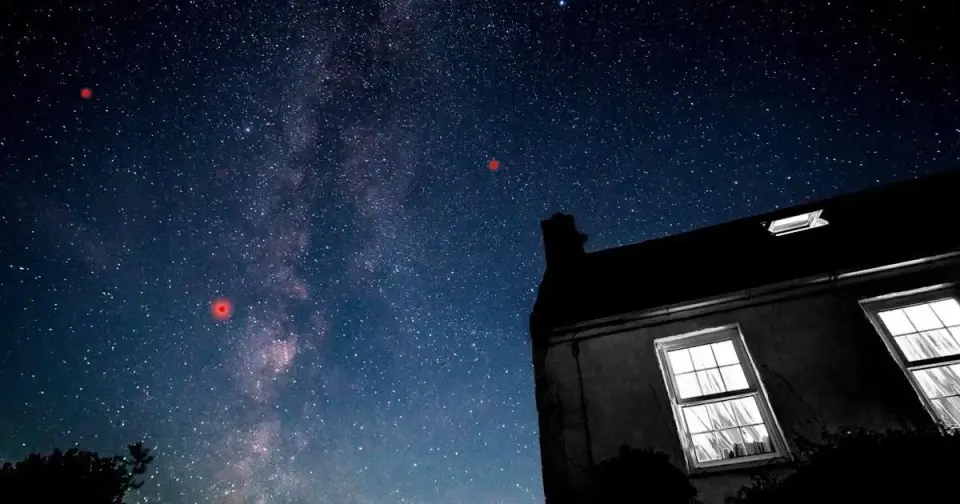
Researchers from Johns Hopkins University have proposed that mysterious 'little red dots' observed by the James Webb Space Telescope may be primordial black holes formed shortly after the Big Bang. Published in Physical Review Letters, the study focuses on object Abell 2744-QSO1, suggesting it grew from a small primordial seed by accreting gas, offering a potential explanation for supermassive black holes existing in the early universe.
Key points
- Johns Hopkins University researchers published a study in Physical Review Letters suggesting 'little red dots' seen by the James Webb Space Telescope could be primordial black holes.
- The study focuses on Abell 2744-QSO1, a red dot located 13.1 billion light-years away, which appears to be composed almost entirely of hydrogen and helium.
- The team modeled three scenarios for QSO1's formation, concluding that a small primordial black hole absorbing surrounding gas is the most likely explanation for its rapid growth.
- Primordial black holes are theorized to have formed from density fluctuations in the early universe, predating the first stars and galaxies.
- The researchers plan to analyze approximately 100 other little red dots to determine if this primordial origin is a common pattern.
Background
Since 2023, the James Webb Space Telescope has detected around 300 'little red dots' in the early universe, appearing as compact, red objects within the first billion years after the Big Bang. Previous theories suggested these objects were standard supermassive black holes obscured by dust or 'black hole stars' undergoing rapid growth. This new study adds a primordial black hole hypothesis to the debate, building on earlier observations that these objects are unusually old and massive for their age.
How outlets are covering it
All sources agree on the core findings of the Johns Hopkins study, but they differ in emphasis. Metro highlights the mystery of the dots and the 'black hole star' alternative, noting that the dots could be ordinary black holes wrapped in dense gas. Space.com and UA.NEWS focus on the technical details of the modeling, emphasizing that while the primordial black hole scenario is the most likely for QSO1, it does not definitively prove the existence of such objects. SadaNews provides a broader context, noting that the study was published in June but announced by Johns Hopkins in November, and stresses that the results do not confirm the discovery of primordial black holes but open a new avenue for testing the hypothesis. The sources also differ in their description of the dots' composition, with some noting the lack of heavy elements as a key indicator of their primordial nature.
Why it matters
This study offers a potential explanation for how supermassive black holes could have formed so early in the universe's history. If confirmed, the existence of primordial black holes would be a groundbreaking discovery in physics, providing insights into the conditions of the early universe and the mechanisms that led to the formation of the first stars and galaxies. The findings could also help distinguish between different types of black holes and improve our understanding of cosmic evolution.
What to watch
The research team plans to analyze approximately 100 other little red dots observed by the James Webb Space Telescope to determine how many could have originated as primordial black holes. They also intend to measure the mass and growth rate of these objects to further test the hypothesis. The results of this expanded analysis could provide stronger evidence for or against the primordial black hole theory.
- Is this the reason behind hundreds of little red dots in the sky? Metro.co.uk
- Webb's controversial 'little red dots' may finally have an explanation Phys.org
- Are James Webb Space Telescope's mysterious Little Red Dots tiny black holes from the Big Bang? Space
- A Mysterious Red Object 13 Billion Years Old Opens the Door for Research on the Earliest Black Holes وكالة صدى نيوز
- Researchers modeled a possible origin of little red dots — Space.com UA.NEWS
Want the full story? Read the original reporting
Read on Metro.co.uk