
JWST’s 'Little Red Dots' Spark Debate Over Black Hole Origins
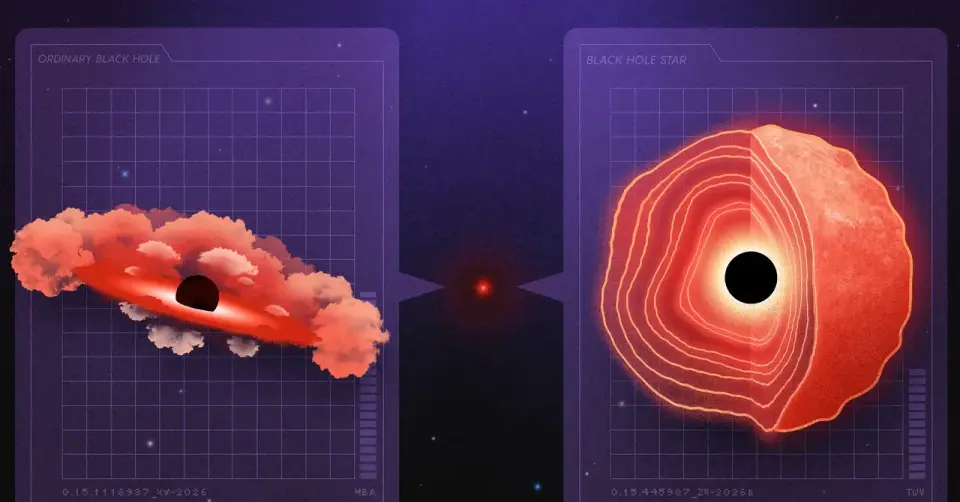
Astronomers are divided on the nature of 'little red dots' (LRDs) observed by the James Webb Space Telescope (JWST) in the early universe. While some propose these are standard supermassive black holes obscured by dust, others argue they represent a new class of 'black hole stars' or transient phases of rapid black hole growth. Recent simulations and spectral analyses suggest LRDs may be young, fast-growing black holes surrounded by dense gas envelopes, potentially explaining the formation of supermassive black holes within the first billion years after the Big Bang.
Key points
- JWST has identified numerous compact, red light sources called 'little red dots' (LRDs) in the early universe, appearing as bright, red-hued objects spanning a single pixel.
- A 2025 debate emerged over whether LRDs are standard supermassive black holes or a new 'black hole star' class, where a black hole is encased in a hydrogen shell that mimics a stellar surface.
- New simulations from the Max Planck Institute suggest LRDs are young, rapidly growing black holes formed from supermassive stars that collapsed into heavy seeds, growing via super-Eddington accretion.
- A study by Jun-Rong Liu et al. proposes that supercritical accretion creates optically thick outflows, forming gas envelopes that match the observed luminosities and temperatures of LRDs.
- Researchers note that LRDs may vanish as the universe ages, suggesting they are a transient 'puberty' phase for supermassive black holes, with some evidence showing them disappearing by 2-3 billion years after the Big Bang.
Background
Prior to 2025, LRDs were initially thought to be distant galaxies, but their brightness and size defied standard cosmic timelines. In September 2026, simulations linked LRDs to rapid black hole growth, suggesting they are transient phases of massive black hole formation. Earlier debates focused on whether LRDs were standard black holes obscured by dust or a new class of 'black hole stars' with hydrogen shells.
How outlets are covering it
Wired highlights the 'black hole star' theory, where a black hole is encased in a hydrogen shell, explaining the red hue and lack of x-rays. Physics World emphasizes simulations showing LRDs as young, fast-growing black holes formed from supermassive stars. AAS Nova focuses on supercritical accretion creating gas envelopes that match LRD spectra. Roberto Maiolino of the University of Cambridge argues that standard black holes with dust or gas clouds can explain LRDs without new theories. Dale Kocevski of Colby College suggests a mix of both, with some LRDs being star-like and others standard black holes.
Why it matters
Resolving the nature of LRDs could explain how supermassive black holes formed so early in the universe, challenging existing models of cosmic evolution. Understanding these objects may reveal new phases of black hole growth and galaxy formation, impacting our knowledge of the early universe's structure and the origins of massive black holes in galaxies today.
What to watch
Astronomers plan to increase simulated black hole formation events to make statistical comparisons with observations. Future studies will test whether LRDs vanish as the universe ages, supporting the 'transient phase' theory. Researchers will also refine models of supercritical accretion and gas envelopes to better match observed spectra and luminosities.
- Inside the Supermassive Debate Over the James Webb Telescope’s ‘Little Red Dots’ WIRED
- Stellar collisions may have been common when the universe was young Phys.org
- Seeing Red: New Constraints on Origin of JWST’s Little Red Dots AAS Nova
- James Webb spots GLIMPSE-17775 shining like a star around a black hole DongA Science
- Astronomers propose solution for ‘little red dot’ mystery Physics World
Want the full story? Read the original reporting
Read on WIRED