
Lab tests show Earth microbes can thrive in simulated Enceladus ocean
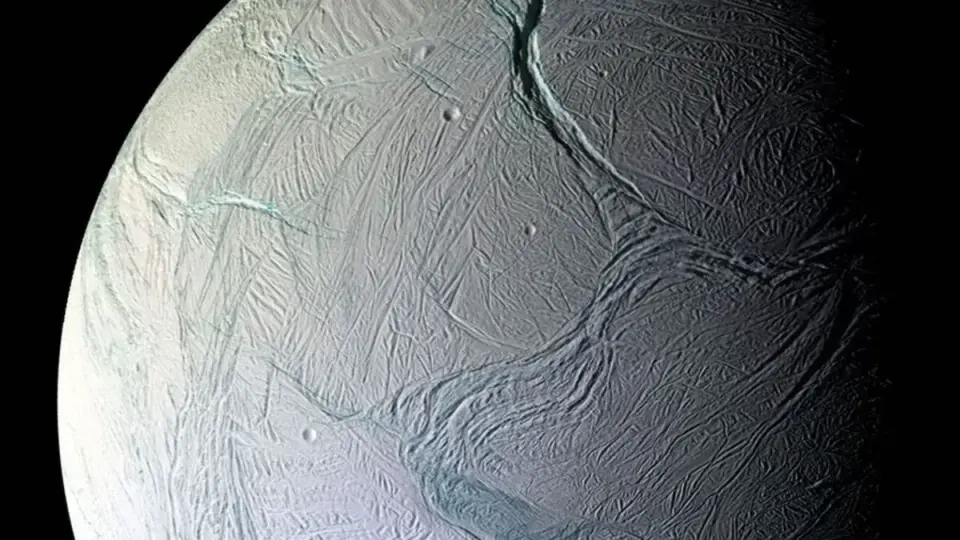
New studies confirm that Earth-based methanogenic microbes can survive in laboratory conditions mimicking Saturn's moon Enceladus. The research also reveals that Enceladus's ice plumes naturally separate and concentrate oceanic compounds, making it easier for future spacecraft to detect potential biosignatures.
Key points
- Researchers at Ludwig-Maximilians-Universität München and Freie Universität Berlin published two studies in Science Advances demonstrating that the microbe Methanothermococcus okinawensis can survive in simulated Enceladus ocean conditions.
- The microbe, which lives near deep-sea hydrothermal vents on Earth, successfully produced methane using hydrogen from water-rock reactions despite the highly alkaline environment (pH 11) and low carbon dioxide levels.
- A second study analyzed Cassini data to show that Enceladus's plumes freeze and fragment, separating different salts and organic materials into individual ice particles, which concentrates potential biological signatures.
- The findings suggest that future missions could easily identify biosignatures in plume samples using current technology, as the moon's natural processes pre-separate oceanic constituents.
- The European Space Agency's L4 mission, proposed for launch around 2042, aims to send a lander to Enceladus's south pole to search for these signs of life, with arrival expected in the 2050s.
Background
Saturn's moon Enceladus has long been a prime candidate for extraterrestrial life due to its subsurface salty ocean and surface plumes. NASA's Cassini spacecraft previously detected organic compounds and salts in these plumes. Recent archive coverage from September 2026 highlighted similar lab tests confirming microbial viability in Enceladus-like conditions, reinforcing the moon's status as a key target in the search for life beyond Earth.
How outlets are covering it
Gizmodo and Sky at Night Magazine emphasize the surprise of the microbial survival, noting that the organisms adapted their metabolism to the harsh, alkaline conditions. The Guardian highlights the broader implications for habitability, quoting William Orsi on the potential for life to survive, while also noting the uncertainty regarding long-term survival. Space.com focuses on the practical aspect of the second study, highlighting how the freezing and fragmenting of plumes simplifies the search for biosignatures. All sources agree that while life has not been found, the conditions are now proven to be potentially habitable for certain Earth microbes.
Why it matters
This research significantly strengthens the case for Enceladus as a habitable world and provides a clear pathway for future missions to detect life. The natural separation of compounds in the plumes reduces the complexity of sample analysis, making the search for biosignatures more feasible with existing technology. This could influence the prioritization and design of upcoming space missions, such as the ESA's L4 mission, aimed at exploring Enceladus in the 2050s.
What to watch
The next major step is the European Space Agency's L4 mission, which plans to launch around 2042 and arrive at Saturn in the 2050s. This mission will include a lander designed to touch down at Enceladus's south pole and analyze plume material for biosignatures. In the meantime, scientists will continue to refine their understanding of long-term microbial survival in Enceladus-like conditions.
- Scientists Find Microbial Life Could Survive on Saturn’s Icy Moon Enceladus Gizmodo
- Microbes could survive on Saturn's moon Enceladus — and scientists think we can find them Space
- Earth microbes survive simulated conditions of Saturn moon’s ocean theguardian.com
- Icy moon around Saturn could hold first signs of alien life The Times
- Saturn's frozen moon could host alien life, say scientists skyatnightmagazine.com
Want the full story? Read the original reporting
Read on Gizmodo