
NASA scientists analyze 1.2-billion-year-old Scottish rocks to decode Martian biosignatures
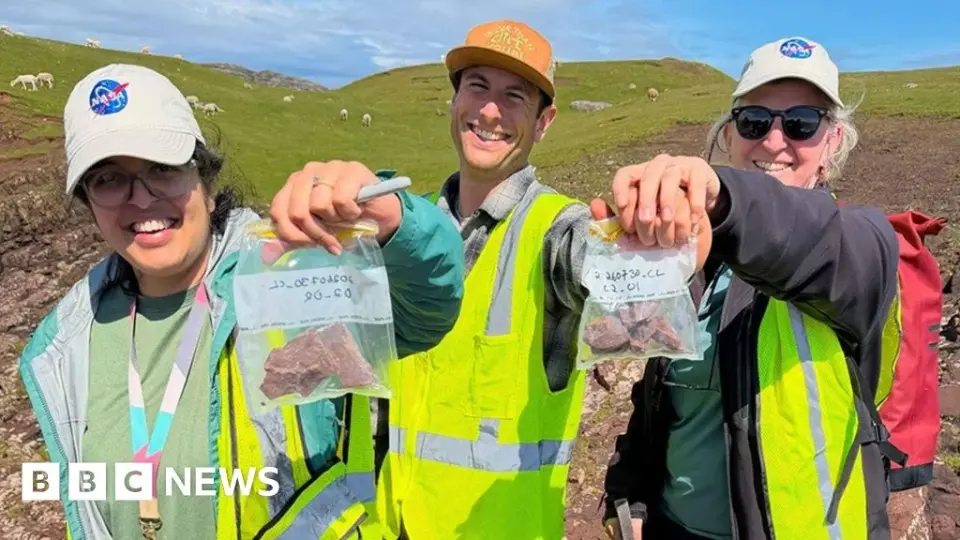
NASA’s Goddard Instrument Field Team visited the Stoer Formation in the Scottish Highlands to study ancient rocks that mirror Martian geology. The mission aims to clarify whether 'reduction spots' found by the Perseverance rover in Jezero Crater indicate microbial life or abiotic volcanic processes. By comparing Earth samples with Mars data, scientists hope to refine detection methods for future sample return missions.
Key points
- NASA scientists collected rock samples from the Stoer Formation near Clachtoll in the Scottish Highlands this summer.
- The expedition focused on 'reduction spots'—grey-green markings in rocks that may indicate ancient microbial activity.
- The Stoer Formation rocks are 1.2 billion years old and formed in environments similar to ancient Martian lakes and rivers.
- The Perseverance rover detected similar markings in Mars’ Jezero Crater, but data remains inconclusive regarding biological origins.
- Collaborators included the Universities of Glasgow and Cambridge, as well as institutions in the US.
- Final confirmation of Martian life may not occur until the Mars Sample Return mission in the 2030s.
Background
This fieldwork follows recent findings from the Curiosity rover, which identified organic molecules in Martian clay, and precedes the planned Mars Sample Return mission. It also aligns with ongoing efforts to improve communication and logistics for Mars exploration, such as the recent Blue Origin contract for a Mars telecommunications network.
How outlets are covering it
BBC and NASA Science emphasize the geological parallel between the Scottish Stoer Formation and Martian Jezero Crater, highlighting the value of Earth analogs for interpreting rover data. The Northern Times provides a more detailed explanation of the scientific dilemma, noting that reduction spots could result from either microbial life or volcanic heat, and stresses that definitive answers require physical sample return. While all sources agree on the expedition’s purpose, NASA Science focuses on the interdisciplinary collaboration and field logistics, whereas the Northern Times highlights the specific chemical ambiguity of the findings.
Why it matters
Understanding how microbial life leaves chemical traces in ancient rocks is critical for interpreting data from Mars rovers. This research helps distinguish between biological and abiotic processes, potentially confirming the existence of past life on Mars and guiding future sample return missions.
What to watch
Scientists will analyze the collected Scottish samples in laboratories to determine how microbes alter rock chemistry. These results will be compared with data from the Perseverance rover. Definitive answers about Martian life are expected only after the Mars Sample Return mission retrieves sealed rock cores from Mars in the 2030s.
- Nasa heads to Scottish Highlands in its search for life on Mars BBC
- In Scotland, NASA Scientists Search for Clues About Mars’ Past NASA Science (.gov)
- NASA analyse ancient Highland rocks in hope of answering question of life on Mars Daily Record
- NASA scientists visit Clachtoll in bid to crack a Martian rock mystery Northern Times
- NASA investigates 1.2 billion-year-old rocks in Scotland to understand Mars’ surface Noticias Ambientales
Want the full story? Read the original reporting
Read on BBC