
ROV Captures First Deep-Sea Evidence of Rudderfish Sheltering with Giant Phantom Jellyfish
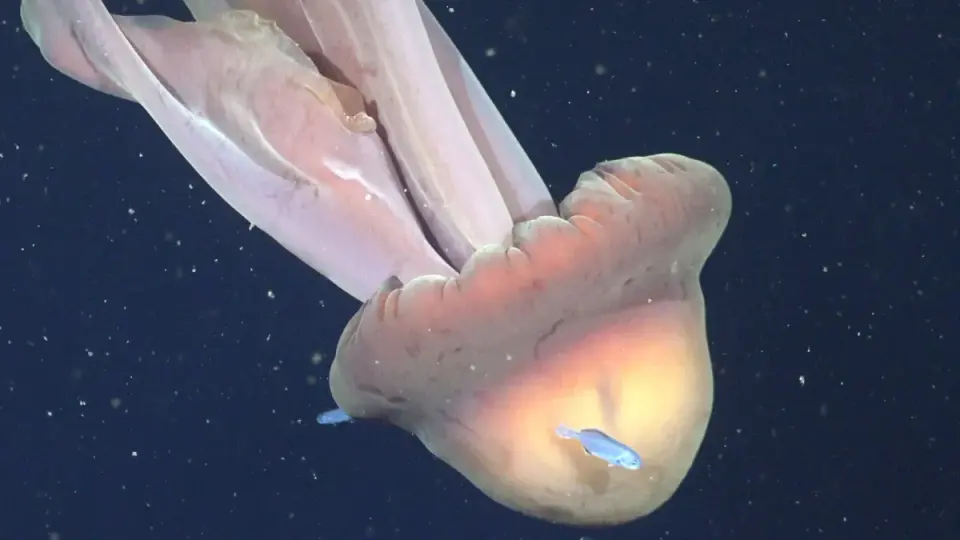
Researchers using a remotely operated vehicle off Argentina confirmed a long-suspected relationship between giant phantom jellyfish and juvenile rudderfish, marking the first visual documentation of this association in the deep ocean.
Key points
- An expedition aboard the Schmidt Ocean Institute's vessel Falkor (too) deployed the ROV SuBastian in December 2025 and January 2026 to explore the Argentine margin.
- At a depth of approximately 250 meters, the team observed a giant phantom jellyfish (Stygiomedusa gigantea) accompanied by about 19 juvenile rudderfish (Centrolophus niger).
- The jellyfish, measuring roughly 6 meters in length, provided a physical barrier that likely protected the small fish from predators in the open water column.
- This observation confirms a hypothesis proposed in 1973 after specimens were found together in North Atlantic trawl catches, but it is the first time the interaction has been seen alive in its natural habitat.
- The study, led by María Emilia Bravo of the University of Buenos Aires, was published in the journal Ecology and highlights the flexibility of interspecies relationships in deep-sea environments.
Background
Deep-sea exploration has historically been limited by the difficulty of human access to mesopelagic zones. While the giant phantom jellyfish has fewer than 120 recorded sightings since its first collection in 1899, recent advances in ROV technology have allowed scientists to observe these elusive creatures in situ rather than just collecting specimens. This discovery follows other recent deep-sea findings, such as amphipods hitching rides on giant sea spiders, suggesting that hitchhiking and shelter-seeking behaviors are more common in the ocean than previously understood.
Why it matters
This finding challenges the assumption that deep-sea species interactions are static or rare. It demonstrates that juvenile fish may adapt their shelter strategies based on local availability, using giant phantoms in the Atlantic as they use barrel jellyfish in the Adriatic. Furthermore, it underscores the vast amount of unknown ecological dynamics in the deep ocean, where species may rely on complex, unobserved relationships for survival.
What to watch
Researchers will continue to analyze the data from the Falkor (too) expedition to determine if the rudderfish provide any benefit to the jellyfish, such as parasite removal, or if the relationship is purely parasitic from the fish's perspective. Further dives may reveal more of the 28 species suspected to be new to science that were identified during this expedition.
Want the full story? Read the original reporting
Read on ScienceAlert