
ESA's Hera Completes Critical Braking Maneuvers to Inspect DART Impact Site
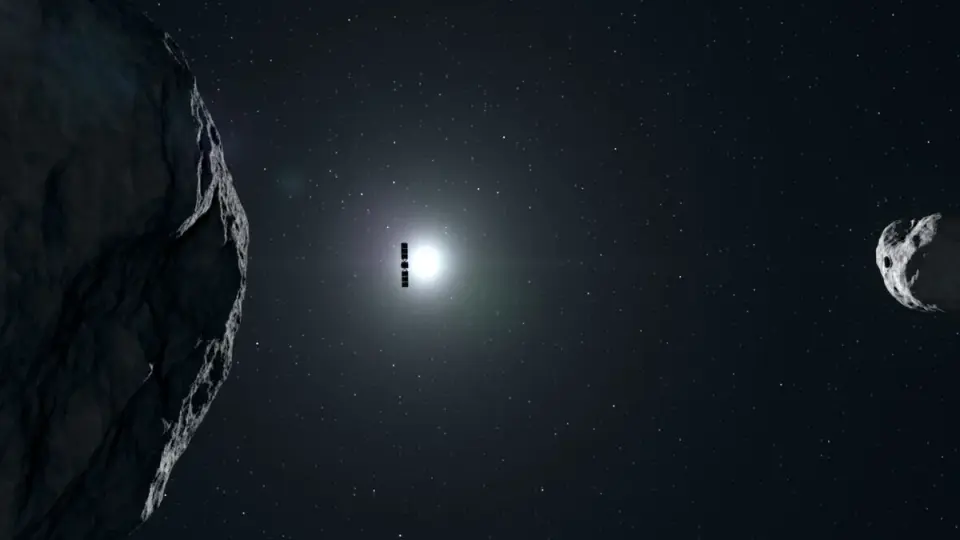
ESA's Hera spacecraft has successfully executed its primary braking maneuvers to align with the Didymos- Dimorphos binary asteroid system. The probe is now on a trajectory to reach the site within 30 kilometers by early November, where it will conduct the first close-up forensic analysis of the crater left by NASA's 2022 DART impact. This mission aims to determine if kinetic impactors are a reliable planetary defense strategy by measuring the asteroid's mass, internal structure, and orbital changes with high precision.
Key points
- Hera performed a 93-minute thruster burn on October 15, followed by a 31-minute burn on October 22, to match the velocity of the Didymos system.
- The spacecraft is scheduled to reach a distance of 30 kilometers from the asteroids in early November, beginning a six-month survey period.
- In January 2027, Hera will deploy two CubeSats: Milani for mineralogical analysis and Juventas for radar sounding and a planned surface landing.
- Ground-based observations from the 2022 DART impact showed a 32-minute reduction in Dimorphos's orbital period, but left a 10% uncertainty in mass calculations.
- Scientists suspect the impact may have caused Dimorphos to tumble uncontrollably, as its orbital period continued to fluctuate for six months post-collision.
Background
This mission follows the 2022 DART experiment, which successfully altered an asteroid's orbit. Recent discoveries of large lunar craters, such as McGetchin, have highlighted the ongoing threat of space debris, underscoring the importance of validating kinetic impact defense strategies. The Hera mission serves as the necessary follow-up to transform the DART success into a repeatable planetary defense protocol.
How outlets are covering it
Gizmodo and ESA emphasize the technical success of the braking maneuvers and the precision required to match the asteroids' velocity. Cristina Iglesias highlights the forensic nature of the mission, noting that DART likely deformed the 'rubble pile' structure of Dimorphos rather than creating a simple crater. IEEE Spectrum focuses on the upcoming imaging capabilities that will reveal the 'scars' of the impact. While all sources agree on the mission's timeline, Cristina Iglesias provides more detail on the potential structural deformation of the asteroid, whereas ESA focuses on the engineering challenges of the thruster burns.
Why it matters
The data collected by Hera will determine if kinetic impactors can reliably deflect asteroids of various compositions and structures. This is critical for developing a dependable planetary defense strategy against future near-Earth object threats. The mission also provides the first detailed survey of a binary asteroid system, which comprises about 15% of known asteroids, advancing our understanding of how these bodies form and behave.
What to watch
Hera will continue to close in on the Didymos system, conducting high-resolution 3D mapping in December 2026. In January 2027, it will deploy the Milani and Juventas CubeSats. Juventas will attempt a surface landing on Dimorphos, marking the first time a spacecraft has landed on an asteroid after a kinetic impact. The mission is expected to continue surveying the system through 2027.
- Hera Closes In on Asteroid Pair to Study the Impact Damage of NASA’s DART Strike Gizmodo
- Hera Mission Prepares for Follow-Up Asteroid Imaging IEEE Spectrum
- Europe’s Hera Probe Arrives at Asteroid Dimorphos to Investigate Historic NASA Crash Site cristinaiglesias.com
- Braking news! Time for ESA’s Hera asteroid mission to go slow European Space Agency
- Four years ago, NASA punched an asteroid. Europe's Hera probe arrives this month to inspect the wreckage Space
Want the full story? Read the original reporting
Read on Gizmodo