
Solar System Collapse Accelerated 100x by Turbulent Stellar Mass Loss
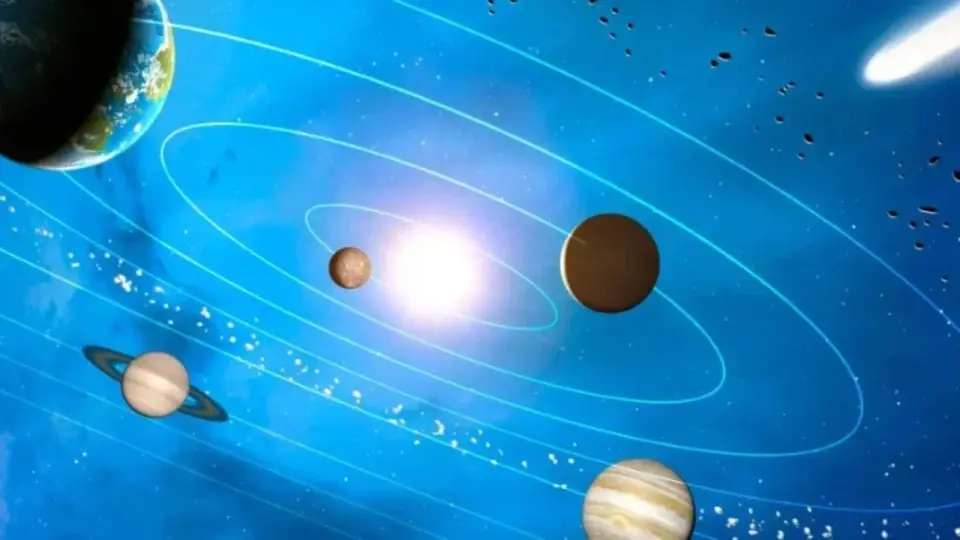
A new study suggests the Solar System may collapse 100 times faster than previously estimated due to turbulent mass loss from the dying Sun. Researchers found that random ejections of solar material will destabilize outer planet orbits, potentially ejecting giants like Saturn within three billion years of the Sun becoming a white dwarf.
Key points
- Konstantin Batygin, Jim Fuller, and Fred Adams published a study in The Astrophysical Journal Letters challenging the assumption that the Sun loses mass smoothly as it becomes a white dwarf.
- The researchers propose that the Sun will eject mass in thousands of discrete, random 'kicks,' each removing about 33 Earths' worth of mass, which alters the Sun's gravitational pull on planets.
- Simulations using data from the ESA's Gaia observatory show that in 80% of realistic scenarios, outer planets begin crossing orbits before the Sun finishes losing its outer layers.
- In 90% of models, the Solar System self-destructs within three billion years after the Sun becomes a white dwarf, a timeline 100 times shorter than previous estimates.
- The study suggests that at least one giant planet will be ejected into interstellar space in nine out of ten simulations, potentially explaining the high number of free-floating planets observed in the galaxy.
Background
This finding follows recent updates to planetary models, such as the September 2026 discovery that Mercury is shrinking 10-30% faster than previously thought due to core cooling. While that study focused on internal geodynamics, the new solar mass loss research addresses external gravitational stability, highlighting a broader trend of revising long-held assumptions about celestial mechanics and planetary evolution.
Why it matters
This research fundamentally alters the predicted lifespan of the Solar System, suggesting that planetary stability is far more fragile than classical mechanics implied. It provides a plausible mechanism for the abundance of rogue planets in the galaxy, linking the death of stars to the scattering of their planetary systems, and confirms Isaac Newton's early suspicions about orbital instability, albeit through internal rather than external causes.
What to watch
Future research will likely focus on refining the parameters of these mass-loss 'kicks' and their specific effects on individual planetary orbits. Astronomers may also use microlensing surveys to look for signatures of ejected planets from dying stars, testing the hypothesis that dying suns are a major source of free-floating worlds.
Want the full story? Read the original reporting
Read on ScienceAlert