
Solar Wind Creates Giant Waves That Strip Mars of Its Atmosphere
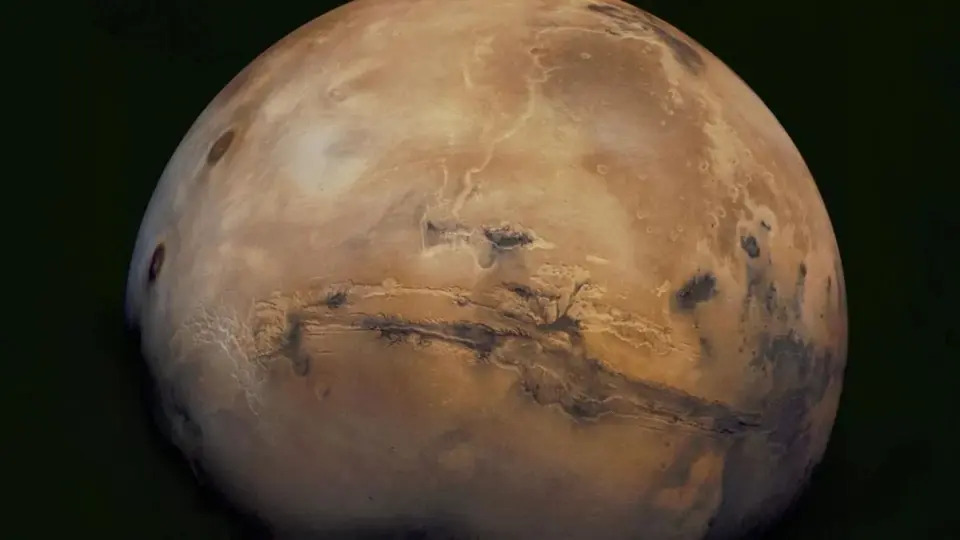
A new study identifies Kelvin-Helmholtz waves as the primary mechanism driving the bulk escape of atmospheric ions from Mars. By combining data from NASA’s MAVEN and China’s Tianwen-1, researchers found that solar wind stirs the planet's upper atmosphere, creating large boundary waves that carry particles into space. This process is not uniform, occurring mainly on one side of the planet depending on the solar wind's electric field direction.
Key points
- Researchers from Boston University published a study in Science Advances identifying Kelvin-Helmholtz waves as the key driver of atmospheric ion loss on Mars.
- The study utilized simultaneous observations from NASA’s MAVEN and China’s Tianwen-1 to link upstream solar wind conditions with atmospheric escape near the planet.
- The atmospheric loss is uneven, concentrated on one side of Mars based on the direction of the solar wind electric field.
- This mechanism helps explain how Mars transitioned from a potentially habitable world with liquid water to a cold, dry desert.
- Future research will focus on the conditions that favor wave formation and their total contribution to atmospheric loss, with NASA’s ESCAPADE mission expected to provide further data.
Background
Mars lost its global magnetic field approximately four billion years ago, leaving its atmosphere exposed to solar wind. Previous research confirmed ongoing atmospheric loss but lacked a clear mechanism for the formation of large plasma clouds responsible for bulk ion escape. This new study builds on earlier 2025 findings that demonstrated the utility of combining MAVEN and Tianwen-1 data to link solar wind variations to Martian atmospheric conditions.
How outlets are covering it
Gizmodo, ScienceDaily, and Rediff all emphasize the analogy between solar wind stirring Mars's atmosphere and wind creating waves on water, highlighting the visual and physical similarity of Kelvin-Helmholtz waves. ScienceDaily provides additional detail on the collaborative nature of the research, noting that MAVEN is nearing mission closeout and that NASA’s ESCAPADE mission will continue this work. NASA’s secondary source focuses on a related but distinct finding regarding Martian auroras, noting that solar storms also strip atmospheric particles, though it does not detail the wave mechanism. All sources agree that the lack of a strong magnetic field is the critical vulnerability for Mars, but only the primary and secondary sources from Boston University explicitly identify Kelvin-Helmholtz waves as the specific driver for bulk escape, whereas NASA’s article focuses on auroral formation.
Why it matters
Understanding the specific mechanisms of atmospheric escape helps explain the dramatic transformation of Mars from a potentially habitable world to its current arid state. This knowledge is crucial for assessing the habitability of other planets and exoplanets that lack strong magnetic fields, as similar processes may be stripping their atmospheres into space.
What to watch
Future research will focus on identifying the specific conditions that favor the formation and growth of Kelvin-Helmholtz waves and quantifying their total contribution to atmospheric escape. NASA’s ESCAPADE mission, which has already launched, is expected to provide new opportunities to investigate solar-wind-driven atmospheric loss at Mars, complementing the legacy of the MAVEN mission.
- Giant Waves of Solar Wind May Have Stripped Mars of Its Atmosphere, New Study Finds Gizmodo
- Giant waves are sweeping Mars’ atmosphere into space ScienceDaily
- Understanding How Martian Auroras Are Made NASA (.gov)
- New Study Reveals How Solar Winds Strip Mars' Atmosphere Rediff
- Elon Musk wants humans to go to Mars, but Sun is killing the Red Planet every day India Today
Want the full story? Read the original reporting
Read on Gizmodo