
Inouye Telescope captures first direct view of solar Kelvin-Helmholtz instabilities
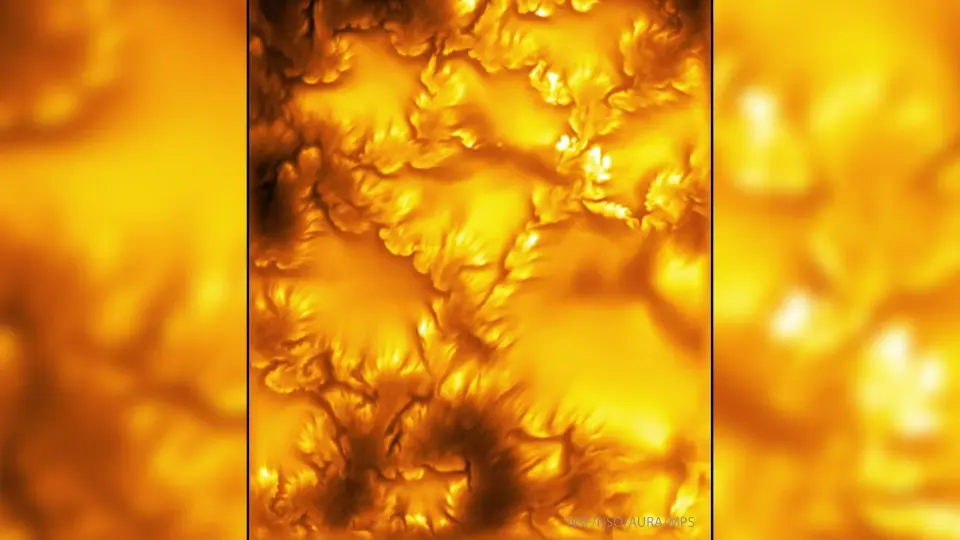
Astronomers have captured the highest-resolution image of the Sun's surface to date, revealing tiny vortices that confirm the presence of Kelvin-Helmholtz instabilities. Published in Nature, these findings explain how magnetic fields twist and heat the solar atmosphere, potentially improving space weather predictions.
Key points
- The NSF Daniel K. Inouye Solar Telescope in Hawaii captured images at 416 nanometers, achieving a resolution of approximately 19 kilometers on the Sun's surface.
- Researchers identified swirling patterns at the edges of solar granules, confirming the long-theorized existence of Kelvin-Helmholtz instabilities (KHI) in the photosphere.
- The study, led by David Kuridze and involving the Max Planck Institute for Solar System Research, matches observational data with high-fidelity computer simulations.
- These vortices are believed to drive 'flux braiding,' twisting magnetic field lines and releasing energy that heats the corona and causes solar flares.
- The findings suggest that micro-scale events, rather than rare massive flares, are the primary drivers of the Sun's magnetic structure and space weather.
Background
Our archive from August 2026 noted that the Inouye Solar Telescope had previously provided unprecedented views of the Sun's photosphere, but this new study marks the first direct confirmation of KHI vortices. Earlier coverage highlighted the telescope's 4-meter mirror and adaptive optics, which are critical for resolving structures as small as 20 kilometers.
How outlets are covering it
Space.com emphasizes the visual achievement, calling it the 'sharpest image ever,' while CNN focuses on the practical implications for space weather and satellite safety. The Max Planck Institute highlights the technical difficulty, noting that resolving these vortices is comparable to seeing a one-euro coin from 180 kilometers away. All sources agree that the findings validate theoretical models, but CNN and the Max Planck Institute stress the link between these micro-vortices and the heating of the Sun's corona, a long-standing mystery in solar physics.
Why it matters
Understanding the mechanism behind solar magnetic energy buildup is crucial for predicting solar flares and coronal mass ejections. These events can disrupt power grids, satellites, and communications on Earth. By identifying the source of magnetic twisting, scientists can improve models of space weather and mitigate its impact on modern infrastructure.
What to watch
Researchers plan to use future observations from the Inouye Solar Telescope to pinpoint the exact physical connections that enable predictions of large flares. The team also intends to expand the analysis of these vortices to other regions of the Sun to determine if the phenomenon is truly ubiquitous across the entire photosphere.
- Sharpest image of the sun ever captured! photo of the day for Aug. 10, 2026 Space
- WATCH: Scientists release most detailed sun images ever PBS
- Unprecedented images reveal hidden process driving solar activity CNN
- Tiny Vortices Discovered on the Sun’s Surface Max-Planck-Gesellschaft
- Ubiquitous Kelvin–Helmholtz instabilities driving plasma mixing on the Sun Nature
Want the full story? Read the original reporting
Read on Space