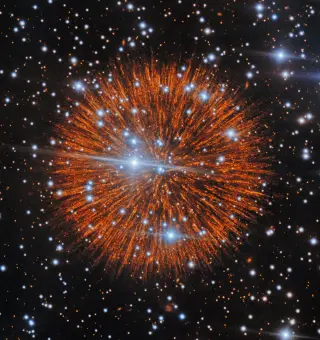
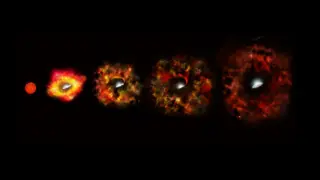
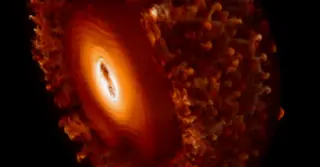
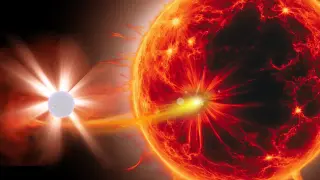
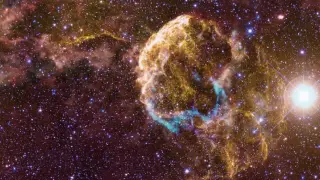
Astronomers have captured the most detailed view yet of Pa 30, the likely remnant of a supernova recorded in 1181. New images from the Gemini North telescope show that the nebula’s filaments are not smooth streaks but chains of tiny gas knots, offering new clues about the explosion's mechanics.
New simulations show neutrinos that change flavor during a dying star’s core collapse can suppress explosions, biasing outcomes toward black holes; this could help explain why fewer supernovas are observed than predicted and why some massive stars yield low‑mass neutron stars, with future work to model neutrino behavior in 3-D.
New modeling shows that neutrino flavor oscillations inside core-collapse supernovae can redistribute energy into non-electron neutrinos, weakening the heating behind the stalled shock and increasing the likelihood of failed explosions, which could help explain discrepancies in observed supernova rates. The result hinges on simplified assumptions and sensitive details like shock density, but points to flavor changes as a potentially important factor in determining a star’s fate.
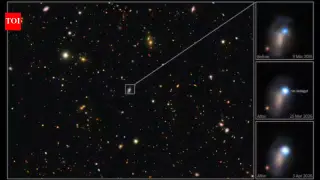
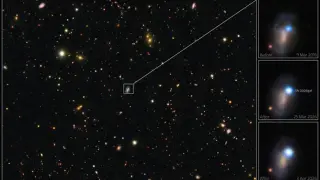
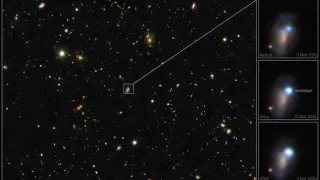
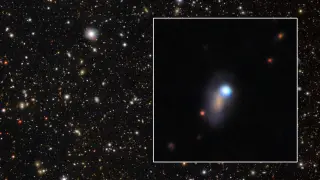
Astronomers have spotted SN 2026aaiv, a Type Ia supernova in spiral galaxy NGC 7331 about 45 million light-years away. First seen by the ATLAS survey on Sept. 1, 2026, the fading explosion is now visible to dedicated amateur observers, at magnitude around 15.7 as of Sept. 11, and can be imaged with a large telescope (roughly 14 inches or more) using averted vision. The SN lies in NGC 7331 near the Great Square of Pegasus, at coordinates RA 22h37m05.618s, Dec +34°24′35.37″. Observers have already captured images with sizable telescopes, highlighting a rare chance for non-professionals to photograph a supernova before it fades. SN 2026aaiv follows another Type Ia SN in the same galaxy, SN 2025rbs, underscoring a Milky Way–like host galaxy’s busy stellar life.
Astronomers compiled a catalog of nearly 3,000 Type Ia supernovae from the Dark Energy Survey and DESI data, finding hints that dark energy’s influence on cosmic expansion may change over time, challenging the standard model that assumes a fixed dark energy. By integrating three decades of observations into a single framework, the study suggests a possible link between gravity and quantum physics and points to future data from the DEBASS program to clarify whether dark energy evolves.
Two papers in Physical Review Letters reveal that massive-star explosions forge and spread elements, with titanium-44 production about 35% higher than previously thought and the nickel-copper cycle playing only a small role in Type I X-ray bursts, enabling more accurate models of how stars create and distribute the universe’s building blocks.
Betelgeuse, the bright red supergiant in Orion, will someday explode as a supernova but likely not for about 100,000 years. New observations strengthen the case that Betelgeuse has a binary companion (Betelgeuse B) hidden in its glare, which could influence its evolution. When it finally collapses, the explosion will unleash an enormous energy burst—mostly in the form of neutrinos—and could heat and strip some mass from the companion, though both stars would largely survive. Earth’s distance would likely keep the event from being catastrophic, but many details about the system and timing remain uncertain.
Astronomers detected an X-ray shock breakout signaling the core collapse of a star about 30 times the Sun’s mass, then watched the resulting broad-lined Type Ic supernova SN 2026gzf for nearly three months across multiple wavelengths. Located ~500 million light-years away, it produced no gamma-ray burst, suggesting jets were choked and the star likely left a black hole, providing a rare, detailed look at the end stages of massive-star evolution.
Astronomers worldwide recorded the first moments of a 500‑million‑light‑year‑distant Type Ic broad‑lined supernova from a Wolf–Rayet progenitor, catching the faint X-ray shock breakout and mapping the star’s pre‑explosion surroundings; the event showed jets but no observed gamma‑ray burst, suggesting a possible choking of the jet, with Rubin Observatory and other facilities continuing long‑term follow‑up observations.
A network of ground- and space-based telescopes, including the Vera C. Rubin Observatory, captured the first moments and subsequent evolution of a Type Ic broad‑lined supernova roughly 500 million light-years away. The observations detail the shock breakout and early light with unprecedented clarity, and follow-up studies found no accompanying gamma-ray bursts, suggesting a possible choked jet. Researchers mapped the star’s pre‑explosion environment around a Wolf‑Rayet progenitor, and Rubin’s continued, high-cadence monitoring will provide long-term data on this event and many future supernovas.
Astronomers tracked SN 2026gzf from its faint X-ray shock breakout to its early light across multiple wavelengths, revealing a broad-lined Type Ic explosion from a Wolf‑Rayet star about 500 million light-years away that did not produce a gamma-ray burst. The rapid, multi-instrument follow-up mapped the explosion and its interaction with surrounding material, suggesting diverse pathways to such energetic deaths beyond GRB jets and shedding light on the star’s final years.
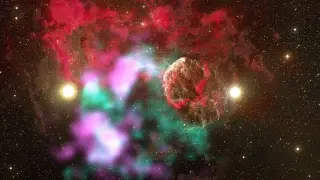
Scientists report evidence that two massive stars in a binary system both exploded as supernovas, creating the Jellyfish Nebula (IC 443) and a nearby nebula (G189.6+3.3). Based on more than a decade of NASA’s Fermi observations, the progenitors were roughly 15–25 and at least 20 solar masses; their explosions occurred tens of thousands of years apart, and the remnants are likely neutron stars. This rare system provides direct clues to how massive binaries evolve and end their lives.
Astronomers analyzing 16+ years of multiwavelength data (including NASA’s Fermi gamma-ray observations) identify IC 443, the Jellyfish Nebula, and the nearby remnant G189.6+3.3 as a likely first binary-star supernova pair: two massive stars that exploded within the same interstellar cloud, about 30–50 light-years apart. IC 443 is estimated at 8,000–9,000 years old, while G189.6+3.3 is older (20,000–110,000 years). The odds of a random alignment are ~1 in 1,000, suggesting a genuine binary progenitor and providing insights into how massive binary stars evolve and end their lives.
Bremont unveils the 41mm Supernova Hawking Limited Edition, a space-inspired chronograph built on the Supernova platform, with meteorite counters, a black-hole motif on the exhibition caseback, DLC-coated 904L steel, 100m water resistance, and a production run of 600 pieces priced at GBP 7,950.
Bremont debuts the Supernova Hawking Limited Edition to celebrate Stephen Hawking, limited to 600 pieces; features a 41mm ultra-black DLC-coated 904L steel case, black ceramic bezel, meteorite sub-dials, and Hawking’s name with his black hole entropy equation on the dial. Powered by the BC77 (Sellita SW500-based) movement at 28,800 bph with a 62-hour power reserve and 100m water resistance. Availability begins July 26, 2026; price US$8,850 on rubber strap and US$9,150 on bracelet; part of Bremont’s Hawking family collaboration.