
Three Observational Frontiers to Decode the Specific Model of Cosmic Inflation
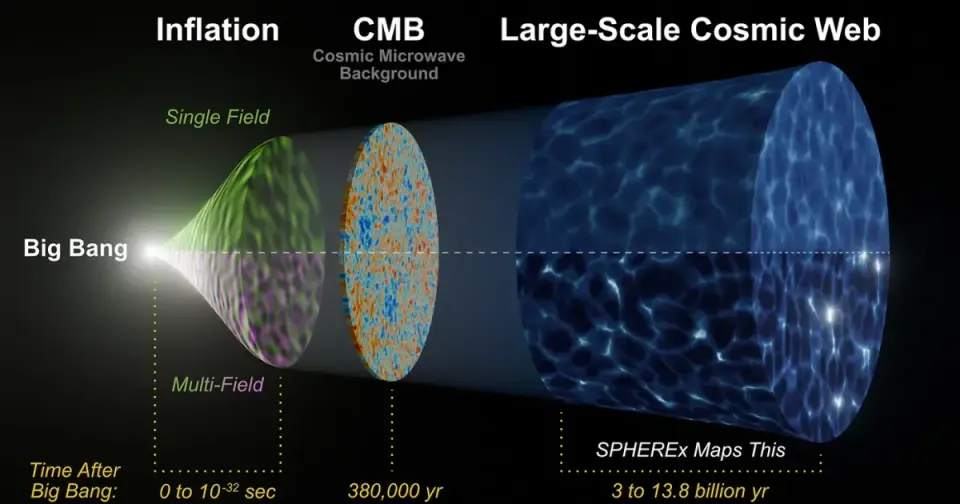
Theoretical astrophysicist Ethan Siegel argues that while the hot Big Bang and preceding cosmic inflation are established, the specific 'flavor' of inflation remains unknown. He identifies three key observational avenues to resolve this: detecting primordial gravitational waves, mapping large-scale structure for non-Gaussian fluctuations, and analyzing small-scale dark matter substructures and seed black holes. These tests utilize upcoming missions like LiteBIRD, DESI, and the Square Kilometer Array to move beyond general confirmation toward precise model validation.
Key points
- The standard cosmological model posits that cosmic inflation preceded the hot Big Bang, solving puzzles like the flatness and horizon problems, but the specific mechanism remains unconfirmed.
- Siegel highlights three critical tests: detecting B-mode polarization from primordial gravitational waves, analyzing the spectral index and non-Gaussianity of density fluctuations via large-scale surveys, and probing small-scale structures through dark matter substructures and early supermassive black holes.
- Current data, such as from the Planck satellite, has constrained the tensor-to-scalar ratio (r) to less than 0.01, but future experiments aim for precision levels of 0.001 or lower to distinguish between inflationary models.
- Upcoming facilities including the Simons Observatory, CMB S4, DESI, Euclid, and the Square Kilometer Array are poised to gather the necessary data to validate or invalidate specific inflationary theories.
- The discovery of overmassive black holes in the early universe, such as QSO1, provides a potential test for whether these seeds were generated by inflationary processes or formed later from cold gas collapse.
Background
This briefing builds on the established scientific consensus that the universe underwent a period of rapid expansion (inflation) before the hot Big Bang. While previous archive entries focused on climate cycles, this article addresses the fundamental origins of the cosmos. The focus has shifted from proving inflation occurred to determining its specific properties, mirroring the progression in dark matter research from existence to characterization.
Why it matters
Determining the specific model of cosmic inflation is crucial for understanding the fundamental laws of physics governing the early universe. Success in these observational tests could validate or refute current theoretical frameworks, potentially revealing new physics beyond the standard model and explaining the origin of large-scale cosmic structures and black holes.
What to watch
Astronomers and cosmologists will deploy next-generation observatories, including LiteBIRD, the Simons Observatory, and the Square Kilometer Array, to collect high-precision data on CMB polarization and large-scale structure. The results from these missions, expected in the coming years, will provide the constraints needed to distinguish between competing inflationary models or reveal unexpected features in the cosmic density spectrum.
Want the full story? Read the original reporting
Read on Big Think