
NASA’s 'Big Bang' Power Swap Extends Voyager 2’s Interstellar Science by at Least One Year
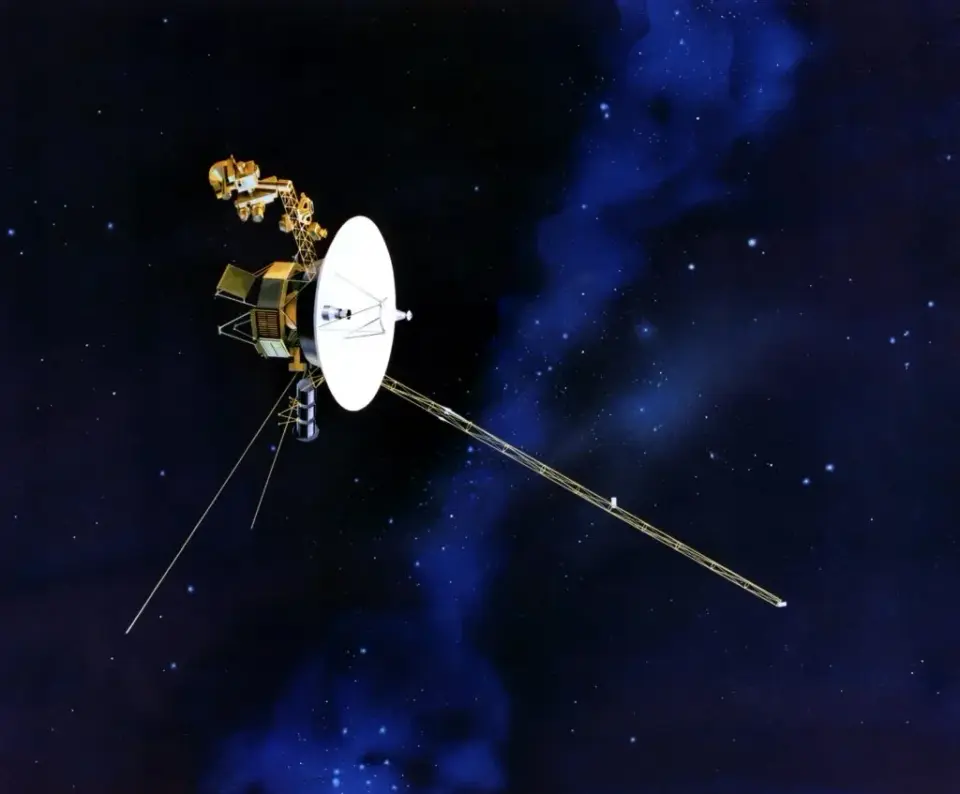
NASA engineers successfully executed a coordinated power and thermal reconfiguration on Voyager 2, known as the 'Big Bang,' to extend its operational life. By simultaneously shutting down an old digital tape recorder and two heaters while activating lower-power alternatives, the probe freed nearly 10 watts of electricity. This move preserves the spacecraft’s three remaining science instruments for at least another year, despite the continuous decline of its plutonium power source.
Key points
- The 'Big Bang' operation involved a simultaneous swap of three devices: an old digital tape recorder and two heaters were turned off, while two new heaters and a propulsion instrument were activated.
- This reconfiguration freed approximately 10 watts of power, which is equivalent to roughly 2.5 years of the probe’s annual power decline.
- The operation was critical because Voyager 2 loses about 4 watts of electrical power per year due to the decay of its plutonium-238 radioisotope thermoelectric generators (RTGs).
- The swap preserved the three active science instruments: the magnetometer, plasma wave subsystem, and cosmic ray subsystem, which measure magnetic fields, plasma density, and energetic particles.
- The procedure required precise thermal management to ensure that turning off high-heat devices did not cause critical components, such as hydrazine thruster lines, to freeze.
Background
Voyager 2, launched in August 1977, is the only spacecraft to have visited Uranus and Neptune. It crossed the heliopause into interstellar space in 2018, six years after Voyager 1. Prior to this recent update, NASA had already retired several instruments, including cameras and heaters, to manage the dwindling power supply. A 2025 power plan had indicated that another instrument would need to be shut down by the end of 2026. The 'Big Bang' maneuver, which had been planned and tested since May 2026, was designed to delay this inevitable shutdown by optimizing the remaining power budget.
How outlets are covering it
Space Daily emphasizes the technical complexity and risk of the 'Big Bang' maneuver, highlighting the 'razor-thin' power margins and the impossibility of physical repair due to the probe’s distance of 143 astronomical units. They note that while the swap freed 10 watts, NASA officially guarantees only one additional year of operation, whereas Scientific American suggests the team hopes for two more years. Vajiram & Ravi provides a broader overview of the mission’s history, confirming the extension of the mission by one year but focusing less on the specific thermal engineering challenges described by Space Daily. Both sources agree that the same reconfiguration is planned for Voyager 1, though success is not guaranteed due to the probes’ different operational histories.
Why it matters
This maneuver demonstrates NASA’s ability to extend the life of aging spacecraft through sophisticated remote engineering, preserving unique data from interstellar space that cannot be replicated by Earth-based observatories. It highlights the critical importance of thermal management in deep-space missions, where power and heat are interdependent resources. The success of this operation on Voyager 2 sets a precedent for similar interventions on Voyager 1, potentially extending humanity’s presence in interstellar space into the 2030s.
What to watch
NASA plans to implement the same 'Big Bang' power reconfiguration on Voyager 1 in the coming months. However, engineers caution that Voyager 1 may not respond identically due to its different thermal and operational history. If successful, this could potentially re-enable the Low-energy Charged Particles instrument on Voyager 1. The long-term goal is to keep at least one science instrument on each probe operating into the 2030s, provided the spacecraft remain healthy.
- Voyager 2 is nearly 50 years old, losing about 4 watts of power every year as its plutonium power source fades — and NASA just bought it at least another year of science with an all-at-once power-system swap engineers called the “Big Bang,” performed on a Space Daily
- NASA Orders 'Power Diet' for Voyager 2, Extending Observation Life by One Year finance.biggo.com
- Voyager 2 Mission, Achievements, Latest News Vajiram & Ravi
Want the full story? Read the original reporting
Read on Space Daily