Voyager 2’s Uranus flyby captured a rare, sun-driven compression of the magnetosphere
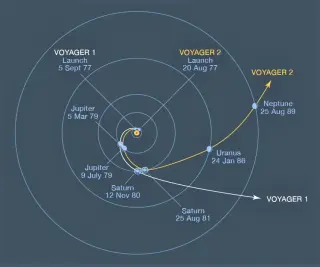
A late-1980s reanalysis shows Voyager 2 arrived at Uranus during an unusually strong solar-wind event that compressed the dayside magnetosphere, shrinking its volume by about 78% in a simplified model. The encounter, though revealing, reflects a rare state (about 4% of similar conditions) rather than Uranus’s normal magnetic environment, and confirms the planet’s tilted, off-center internal field. The study also links the intense radiation belts to compression and notes the possible but not definitive absence of plasma from moons. A future Uranus orbiter would be needed to map the magnetosphere’s time evolution beyond a single flyby.