Tag

Interstellar Space

All articles tagged with #interstellar space

Voyager 1's two-day command cycle as it drifts toward interstellar space
science2 days ago

Voyager 1's two-day command cycle as it drifts toward interstellar space

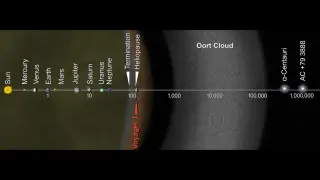
Voyager 1 is about 16 billion miles from Earth and moving away from the Sun, so a command sent at the speed of light takes roughly 22.5 hours to reach it and the reply takes about 22.5 hours to return, creating a two‑day command‑and‑response cadence. After a memory‑chip failure in 2023, a 2024 patch and careful line‑by‑line code review restored coherent data transmission, and the current data rate is about 160 bits per second as the probe slowly powers down its instruments. By November 2026 Voyager 1 will become the first human‑made object to pass one light‑day from Earth, while Voyager 2 remains on a longer, slower path toward similar autonomy and fading transmissions.

Voyager 1 closes in on one-light-day distance as Earth awaits a full-day signal round-trip
science8 days ago

Voyager 1 closes in on one-light-day distance as Earth awaits a full-day signal round-trip

Voyager 1’s communications have grown so distant that one-way signals now take over 23 hours to reach Earth, with projections toward roughly 24 hours by late 2026. As the probe cruises outward at about 17 km/s, the data arriving on Earth corresponds to a position the spacecraft has already left, effectively making the telemetry a late snapshot from interstellar space. The milestone of one light-day (about 25.9 billion km) will be reached around November 2026, turning every command a full day to arrive and a full day for a reply. The data stream remains slim (roughly 160 bits per second), and only two instruments on Voyager 1 stay active, with power-management decisions looming as NASA relies on DSN facilities like Canberra’s DSS-43 for ground control. Voyager 2, on a different path, won’t reach this mark for years, and both probes continue to operate as the few direct data sources from beyond the heliosphere, even as power fades and operations tighten.

NASA Extends Voyager 1’s Deep-Space Mission by Shutting Down a 49-Year-Old Sensor
science20 days ago

NASA Extends Voyager 1’s Deep-Space Mission by Shutting Down a 49-Year-Old Sensor

To conserve dwindling power from its plutonium RTG, NASA turned off the Low-energy Charged Particles (LECP) instrument on Voyager 1 after 49 years, a decision that preserves essential systems and could buy roughly one more year of operation in interstellar space; a small portion of LECP will stay active, and engineers plan a broader, lower-energy 'Big Bang' power-saving approach to be tested on Voyager 2 in 2026 and possibly applied to Voyager 1 afterward.

Voyager 1 May Get a Lifeline With Bold Power-Swap to Extend Interstellar Mission
science28 days ago

Voyager 1 May Get a Lifeline With Bold Power-Swap to Extend Interstellar Mission

Voyager 1 has shut down its Low-energy Charged Particles (LECP) instrument to conserve power as it travels farther into interstellar space. NASA plans a bold, one-shot power-swap—a “Big Bang” fix—by turning off some systems and switching to lower-power options, first on Voyager 2 and then on Voyager 1, to keep two remaining instruments alive for about a year and potentially extend the mission toward its 50th anniversary, with the hope LECP could be revived later if power allows.

Voyager 1 Trims Instruments to Stretch Interstellar Mission
science28 days ago

Voyager 1 Trims Instruments to Stretch Interstellar Mission

NASA's Voyager 1 has shut down the Low-energy Charged Particles instrument to conserve dwindling power from its aging RTGs. The move is part of a broader “Big Bang” plan to power down nonessential systems and keep heaters on, allowing the mission to continue collecting data beyond the heliosphere. Voyager 2 has already shed similar instruments, and planners will test the approach in May–June with the goal of implementing it on Voyager 1 by July, potentially reactivating LECP if more power becomes available.

Voyager 1 pauses a science instrument to extend its interstellar mission
space29 days ago

Voyager 1 pauses a science instrument to extend its interstellar mission

NASA commanded April 17 to shut down Voyager 1’s Low-energy Charged Particles instrument to conserve power as it drifts deeper into interstellar space, mirroring a similar move on Voyager 2 last year. Engineers hope a bold “Big Bang” power-swap upgrade—first tested on Voyager 2 this spring and then on Voyager 1 in July—will keep the venerable probes producing data for about another year, helping mark Voyager 1’s 50th anniversary while two other instruments remain active.

Voyager at 49: Five-Year Mission Becomes a Half-Century of Cosmic Discovery
space1 month ago

Voyager at 49: Five-Year Mission Becomes a Half-Century of Cosmic Discovery

Voyager 1 and Voyager 2, launched in 1977, are nearing the end of their missions as decaying Plutonium-238 power forces NASA to shut down instruments; yet after almost five decades they’ve delivered unprecedented data from the outer planets and now interstellar space, and NASA hopes to extend their lives into the 2030s while newer observatories—Rubin Observatory, James Webb, Hubble, and the upcoming Roman Space Telescope—carry the torch of cosmic exploration.

Power-Saving Move Extends Voyager 1’s Lifespan
space1 month ago

Power-Saving Move Extends Voyager 1’s Lifespan

NASA has shut down the Low-energy Charged Particles (LECP) instrument on Voyager 1 to conserve power and extend the mission, keeping two other instruments active as the spacecraft—more than 15 billion miles from Earth—drifts through deep space; a 0.5-watt motor on LECP remains running to keep the door open for possible reactivation, while the RTG’s power slowly declines by about 4 watts per year.

Voyager 1 Trims Instrument Power as NASA Tests Bold Energy-Saving Plan
space1 month ago

Voyager 1 Trims Instrument Power as NASA Tests Bold Energy-Saving Plan

NASA shut down Voyager 1’s Low-Energy Charged Particles instrument to conserve dwindling power as it sails through interstellar space about 15 billion miles from Earth, and is pursuing a broader energy-saving fix nicknamed 'Big Bang' to swap in lower-power systems, hoping to buy roughly a year of additional operation while seven of the original ten instruments have been turned off (Voyager 2’s LECP was shut down in 2025). The shutdown sequence takes hours and is driven by distance-related command delays, with one small motor kept active to allow possible future restart.

NASA downshifts Voyager 1 instrument to stretch its interstellar voyage
space1 month ago

NASA downshifts Voyager 1 instrument to stretch its interstellar voyage

NASA engineers shut down the Low-energy Charged Particles (LECP) instrument on Voyager 1 on April 17 to conserve dwindling nuclear power, allowing the spacecraft to continue studying the interstellar medium beyond the solar system. Voyager 2’s LECP was silenced earlier in 2025, and only a handful of instruments remain active on both Voyagers. Voyager 1 is currently more than 15 billion miles (about 24 billion kilometers) from Earth, making it the farthest human-made object, and the instrument shutdown is part of a planned retirement sequence to maximize science as the power supply declines.

Voyager 1 Shuts Down a Sensor to Stretch Its Interstellar Mission
space1 month ago

Voyager 1 Shuts Down a Sensor to Stretch Its Interstellar Mission

NASA’s Voyager 1 cut power to the Low-energy Charged Particles instrument to conserve energy after a power drop, leaving two instruments still operating as the aging probe drifts through interstellar space. The shutdown buys about a year while engineers pursue a long-term, lower-power “Big Bang” fix to swap in efficient hardware and extend the mission's life.

NASA Sacrifices Voyager 1 Instrument to Keep Interstellar Mission Alive
science1 month ago

NASA Sacrifices Voyager 1 Instrument to Keep Interstellar Mission Alive

Facing a dwindling nuclear power source, NASA shut down Voyager 1’s Low-energy Charged Particles (LECP) instrument to conserve energy and prevent an automatic shutdown, as its power declines by about four watts per year. Only two instruments remain online—plasma waves and magnetic fields—with a bold plan dubbed the Big Bang to swap in lower‑power components on Voyager 2 first, then Voyager 1, in hopes of keeping the mission alive for at least another year while continuing exploration of interstellar space.

Voyager 1 Trims Its Payload to Push Deeper into Interstellar Space
science1 month ago

Voyager 1 Trims Its Payload to Push Deeper into Interstellar Space

NASA has shut down Voyager 1’s Low-energy Charged Particles instrument to conserve dwindling power as the probe—about 15 billion miles from Earth—continues its interstellar voyage; seven of its ten instrument sets have been turned off so far, with Voyager 2’s LECP already disabled, and the team plans further shutdowns along with a 'Big Bang' power swap to keep data flowing from beyond the heliosphere.

Voyager 1’s power squeeze prompts bold plan to keep exploring
science1 month ago

Voyager 1’s power squeeze prompts bold plan to keep exploring

NASA says Voyager 1 — launched in 1977 and the most distant human-made object — is losing about 4 watts of power each year from its plutonium-powered generator. After a dip in energy forced the shutdown of the Low-energy Charged Particles instrument, engineers are pursuing a “far-out plan” to extend the probe’s life as it continues to study interstellar space beyond the heliosphere.