
Voyager's Griffin-1 Lander Clears Final Hurdles for Late 2026 Lunar South Pole Mission
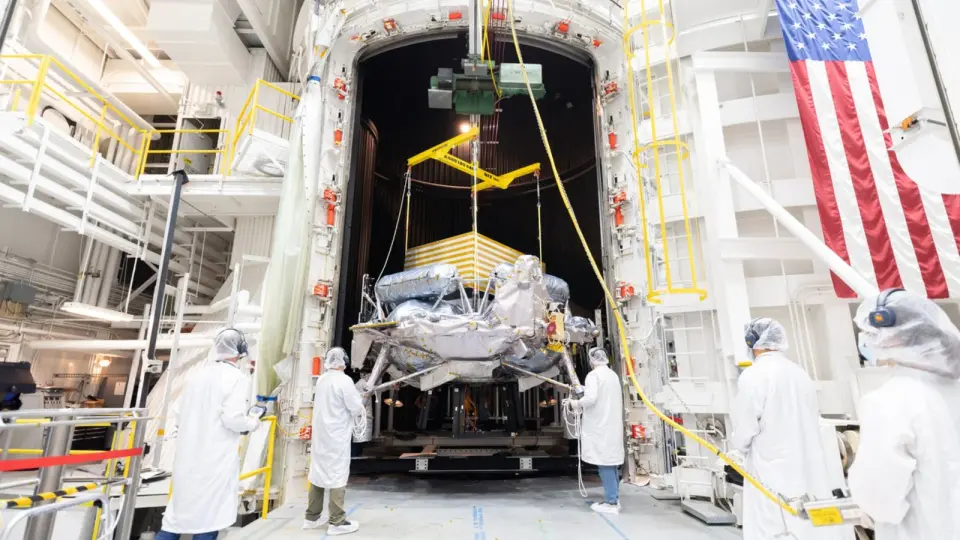
Voyager Technologies' Griffin-1 lunar lander has successfully completed rigorous environmental testing at NASA's Jet Propulsion Laboratory, clearing the path for its launch later in 2026. The spacecraft, which will carry over 1,100 pounds of cargo to the lunar south pole, is a key component of NASA's Commercial Lunar Payload Services initiative. Its mission includes deploying Astrolab's FLIP rover, a vehicle equipped with a supercomputer, to test technologies for future crewed lunar bases. While Griffin-1 is on track to launch this year, it faces a competitive landscape where other commercial landers have faced delays or failures, making its success a critical milestone for sustained lunar exploration.
Key points
- Griffin-1 passed environmental tests at JPL, including exposure to 153 decibels of acoustic noise and extreme temperature simulations, confirming its readiness for launch.
- The lander is scheduled to launch later in 2026 on a SpaceX Falcon Heavy rocket from Kennedy Space Center, marking the fourth Falcon Heavy mission of the year.
- The mission will deliver 10 payloads from six countries to the lunar south pole, including Astrolab's FLIP rover, which features a history-making supercomputer.
- Voyager selected the landing site near Mons Mouton using custom software to analyze lighting, hazards, and terrain, ensuring a safe touchdown for the lander and its cargo.
- This mission is part of NASA's CLPS program, which aims to build infrastructure for a future crewed lunar base, with NASA Administrator Jared Isaacman signaling an increase in task orders starting in 2027.
Background
The Griffin-1 mission is the latest in a series of commercial lunar attempts under NASA's CLPS program. Previous missions, such as Intuitive Machines' Nova-C and Firefly's Blue Ghost, have had mixed results, with some landing successfully and others failing. Voyager's predecessor, Astrobotic's Peregrine, failed to land in 2024. The success of Griffin-1 is crucial as NASA ramps up its efforts to establish a sustained presence on the moon, with Artemis III and IV missions planned for 2027 and 2028, respectively.
How outlets are covering it
Space.com and UA.NEWS focus on the successful completion of environmental tests at JPL, highlighting the rigor of the testing process and the significance of the mission for future lunar exploration. Voyager Technologies provides a detailed account of the landing site selection process, emphasizing the use of custom software and simulations to ensure a safe landing near Mons Mouton. The Orlando Sentinel offers a broader context, noting that Griffin-1 is the only commercial lander currently on track to launch in 2026, while other competitors like Blue Origin and Intuitive Machines face delays due to technical issues and rocket failures. This perspective underscores the competitive and challenging nature of commercial lunar exploration.
Why it matters
The success of Griffin-1 is a critical step toward NASA's goal of establishing a sustained presence on the moon. The mission will test new technologies and infrastructure that will be essential for future crewed missions, including the Artemis IV landing in 2028. Additionally, the mission's success could set a precedent for commercial lunar exploration, demonstrating the viability of private companies in supporting NASA's long-term goals.
What to watch
Griffin-1 is expected to launch later in 2026 on a SpaceX Falcon Heavy rocket. After launch, the lander will travel to the lunar south pole, where it will deploy its payloads, including the Astrolab FLIP rover. The mission's success will be a key indicator of the progress of NASA's CLPS program and the readiness of commercial companies to support future lunar exploration. NASA is also planning to increase the number of CLPS task orders starting in 2027, with a goal of 20 robotic missions by 2029.
- Private Griffin moon lander gets put to the test photo of the day for Oct. 23, 2026 Space
- How Voyager Chose Griffin-1’s Lunar Landing Site Voyager Technologies
- Griffin-1 lunar lander passes critical tests ahead of Moon flight — Space.com UA.NEWS
- At least 1 lunar landing company may get off a moonshot this year Orlando Sentinel
Want the full story? Read the original reporting
Read on Space