
Zhurong Rover Finds Late-Age Gypsum Crystals Hinting at Preserved Martian Brine
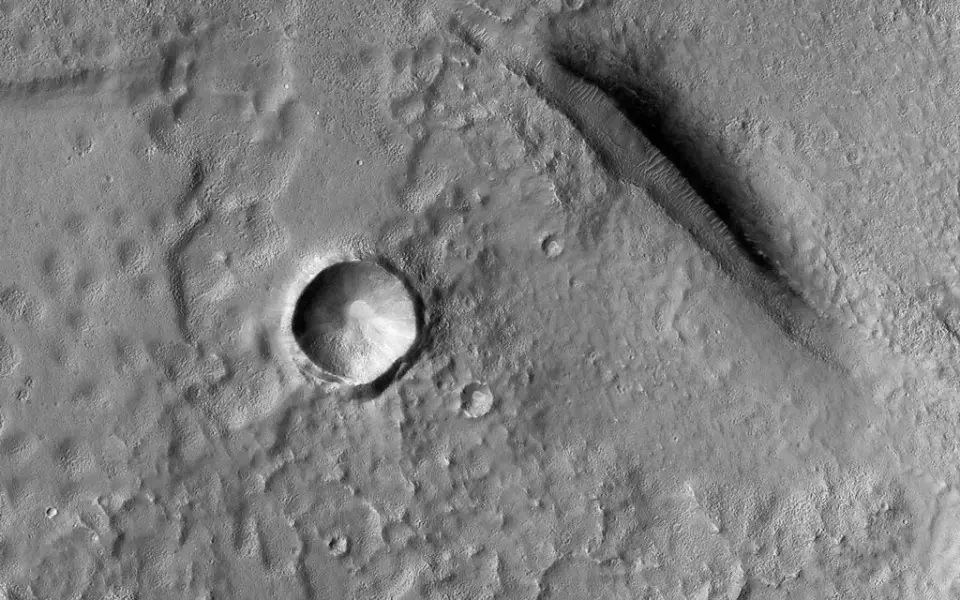
China’s Zhurong rover identified large selenite gypsum crystals in southern Utopia Planitia, suggesting liquid water persisted on Mars until roughly 760 million years ago. The crystals may contain microscopic fluid inclusions preserving ancient brine chemistry, though direct observation remains unconfirmed.
Key points
- Zhurong’s spectrometers detected gypsum (calcium sulfate dihydrate) in a 5–10 cm thick layer, with crystal shapes matching terrestrial selenite.
- The deposit is dated to approximately 760 million years ago via crater counts, indicating water activity long after Mars’s early wet period.
- Researchers propose the crystals formed from brine concentrated by freezing, potentially trapping microscopic fluid inclusions that could preserve water chemistry.
- No inclusions have been directly observed; confirming their presence requires future microscopy or sample return missions.
- The discovery suggests episodic, local liquid water in a cold Martian environment, rather than a return to global warmth.
Background
This finding extends the timeline of Martian water activity beyond the Amazonian period’s early stages. Previous missions, including Curiosity and Perseverance, have identified hydrated minerals and clay deposits, but this study highlights a much later episode. The archive notes that sample return missions face strict contamination controls, which would be critical for analyzing any potential inclusions from this site.
How outlets are covering it
Space Daily emphasizes the potential for preserved fluid inclusions as a key testable prediction, noting that Zhurong lacked the tools to verify them. Universe Today focuses on the broader challenge of locating subsurface ice for future human missions, highlighting gaps in current mapping technology. Earth.com discusses ancient clay deposits at the Rosalind Franklin landing site, suggesting a different, much older (4 billion years) water history. Live Science references meteorite data suggesting water loss began over 4 billion years ago, contrasting with the recent 760-million-year-old gypsum finding. The outlets differ in their focus: Space Daily on crystal chemistry, Universe Today on resource utilization, Earth.com on ancient oceans, and Live Science on long-term atmospheric loss.
Why it matters
If confirmed, these crystals could provide a direct chemical record of Mars’s late water history, offering insights into habitability and potential biosignatures. The discovery challenges the view that Mars became arid early in its history, suggesting complex, episodic water cycles persisted much longer. It also informs future mission planning, as such sites could be targets for sample return or in-situ analysis to test for preserved fluids.
What to watch
Future missions will need to verify the presence of fluid inclusions through high-resolution microscopy or sample return. Researchers are also working to improve subsurface ice mapping to better understand water distribution. The findings may influence the selection of landing sites for missions like Rosalind Franklin, which aims to search for biosignatures in ancient clay deposits.
- Gypsum crystals discovered by Zhurong on roughly 760-million-year-old Martian terrain may still contain microscopic pockets of the brine they grew from — tiny sealed samples that could preserve the chemistry of liquid water from a surprisingly recent chapter Space Daily
- What a dry meteorite tells us about water on Mars Phys.org
- The Odds of Finding Water on Mars Universe Today
- Scientists believe a vast ocean once covered the landing site of the ExoMars Rosalind Franklin rover Earth.com
- Minerals associated with plate tectonics found in oldest rock from Mars — a planet with no plate tectonics Live Science
Want the full story? Read the original reporting
Read on Space Daily