
Asteroid 1999 AN10 to pass within lunar distance of Earth in August 2027
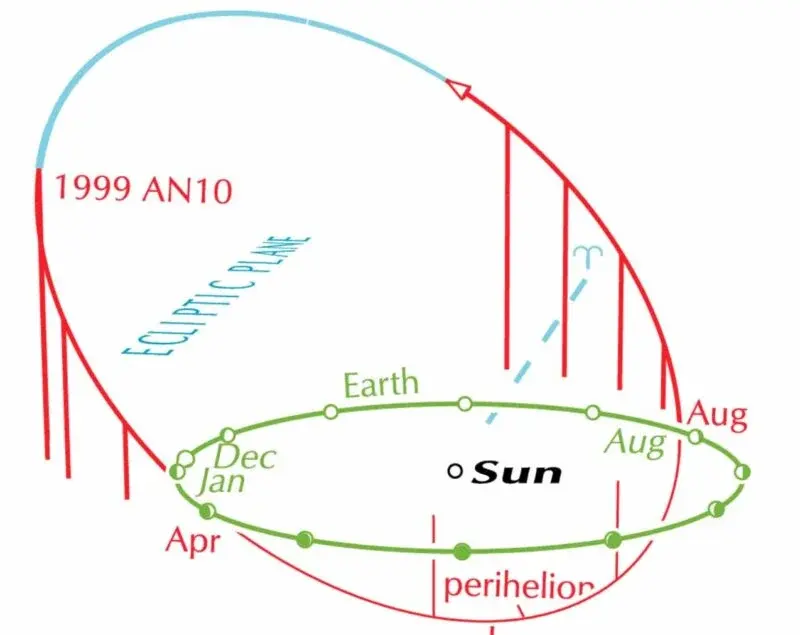
Asteroid 1999 AN10, estimated to be 800 to 1,800 meters wide, will pass Earth at a distance of approximately 389,855 kilometers on August 7, 2027. This distance is roughly equivalent to the average distance between Earth and the Moon. Although classified as potentially hazardous by NASA due to its size and orbital characteristics, the asteroid poses zero risk of impact during this flyby. The object will be visible to observers in the Americas with binoculars, reaching a peak brightness of magnitude 7.3. It will traverse the constellations Taurus, Aries, Pisces, and Pegasus during its closest approach at 7:12:05 UTC. The asteroid, discovered in 1999, follows an elongated orbit that crosses Earth's path, but current calculations confirm no collision threat.
Key points
- Closest approach occurs on August 7, 2027, at 7:12:05 UTC.
- Separation distance is approximately 389,855 kilometers (242,240 miles), roughly one lunar distance.
- Estimated diameter ranges from 800 to 1,800 meters (0.5 to 1.1 miles).
- Peak brightness will reach magnitude 7.3, making it visible with binoculars from North and South America.
- The asteroid will pass on the opposite side of Earth from the Moon, with a minimum distance to the Moon of 763,391 kilometers.
- NASA classifies it as potentially hazardous because it is larger than 140 meters and comes within 0.05 AU of Earth, but impact probability for 2027 is zero.
Background
This event follows recent astronomical observations, including the confirmation of Earth-sized planets in the 70 Ophiuchi binary system and the discovery of temporary minimoon 2026 QQ8. While 2026 QQ8 is a tiny 2-meter rock captured by Earth's gravity, 1999 AN10 is a much larger Apollo-class asteroid with an orbital period of 643 days. It was first discovered on January 13, 1999, at the Lincoln Laboratory Experimental Test Site in New Mexico. Other notable potentially hazardous asteroids, such as 99942 Apophis and 101955 Bennu, have also had close approaches or are subjects of ongoing study, but 1999 AN10's 2027 pass is distinct in its visibility and safety profile.
Why it matters
The 2027 flyby of 1999 AN10 offers a rare opportunity for public observation of a large, potentially hazardous asteroid passing within lunar distance. While it poses no threat, its size and proximity highlight the importance of tracking such objects. NASA notes that an impactor of this size could have global consequences if it were to strike Earth, emphasizing the value of continued monitoring. The event also serves as a reminder that while potentially hazardous asteroids are common, the vast majority pose no immediate danger, and accurate orbital tracking is crucial for distinguishing between potential risks and safe passes.
What to watch
Astronomers will continue to monitor 1999 AN10's trajectory as it approaches its closest point on August 7, 2027. Observers in the Americas can attempt to spot the asteroid with binoculars during the night of August 7, as it moves through Taurus, Aries, Pisces, and Pegasus. Following this encounter, attention will shift to other potentially hazardous asteroids, including 2001 WN5, which is expected to pass inside the Moon's orbit in June 2028, and 1997 XF11, which will approach in October 2028. NASA and other agencies will maintain tracking to ensure no future orbital changes pose a threat.
Want the full story? Read the original reporting
Read on EarthSky