
BepiColombo Enters Mercury Orbit After Eight-Year Journey
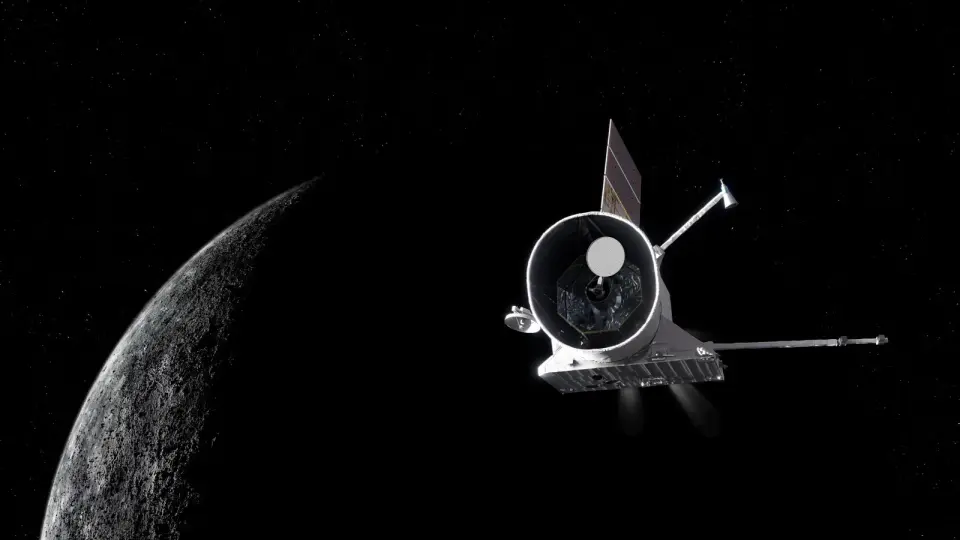
The joint European-Japanese BepiColombo mission has successfully entered orbit around Mercury, marking the end of an eight-year voyage. The mission, comprising two spacecraft, will now begin a six-month arrival phase before separating in December to study the planet's surface, magnetic field, and interior. Science operations are scheduled to commence in April 2027.
Key points
- BepiColombo arrived in Mercury orbit on November 21, 2026, following a 37-minute orbit-insertion burn.
- The mission consists of ESA's Mercury Planetary Orbiter (MPO) and JAXA's Mercury Magnetospheric Orbiter (Mio).
- The two spacecraft will remain connected until December 9, after which they will separate to begin independent orbits.
- The journey took eight years instead of the planned seven due to a solar panel issue that reduced power for the transfer module.
- The Mercury Imaging X-ray Spectrometer (MIXS) successfully tested its capabilities by observing the Crab Nebula before arrival.
- Full science operations are scheduled to begin on April 6, 2027.
Background
BepiColombo is the second spacecraft to orbit Mercury, following NASA's MESSENGER mission. The mission launched in October 2018 from French Guiana. It is designed to study Mercury's magnetic field, internal structure, and surface composition. The arrival phase began on September 3, 2026, when the Mercury Transfer Module separated from the orbiters. The mission faces challenges due to Mercury's proximity to the Sun, which requires complex braking maneuvers to achieve orbit.
How outlets are covering it
Space.com emphasizes the technical success of the orbit-insertion burn and the timeline for the arrival phase. BBC highlights the extreme environmental conditions of Mercury, including temperature fluctuations and solar radiation, and notes the mission's role in solving mysteries like polar ice and surface hollows. ScienceDaily focuses on the success of the UK-built MIXS instrument, which passed its first light test by observing the Crab Nebula, confirming its functionality after eight years in space. National Geographic discusses the broader scientific implications, particularly regarding Mercury's large iron core and how the mission will help resolve debates about the planet's formation, whether through a giant impact or innate composition.
Why it matters
BepiColombo represents a significant advancement in planetary science, providing the first detailed mapping of Mercury's surface and magnetic environment. The mission's dual-orbiter design allows for complementary data collection, which is crucial for understanding the planet's internal structure and its interaction with the solar wind. The successful operation of the MIXS instrument demonstrates the resilience of advanced space technology over long-duration missions. The data collected will help scientists understand the formation and evolution of rocky planets, particularly those close to their stars, offering insights into exoplanet systems.
What to watch
The two spacecraft will separate on December 9, 2026. Mio will enter a highly elliptical polar orbit, while MPO will undergo a series of burns to reach its final orbit by March 10, 2027. Full science operations are scheduled to begin on April 6, 2027. The mission will continue to study Mercury's surface, magnetic field, and exosphere for at least one year.
- European-Japanese BepiColombo probe arrives in orbit around Mercury today Space
- Mercury-bound X-ray telescope delivers first images after eight years in space Phys.org
- BepiColombo spacecraft arriving at Mercury after eight years BBC
- After 8 years in space, a groundbreaking X-ray telescope finally opens its eyes ScienceDaily
- A New Mission Arrives at Mercury, the Solar System's Most Mysterious Planet National Geographic
Want the full story? Read the original reporting
Read on Space