
Caltech robot assembles first autonomous space structure, validating DARPA’s NOM4D program
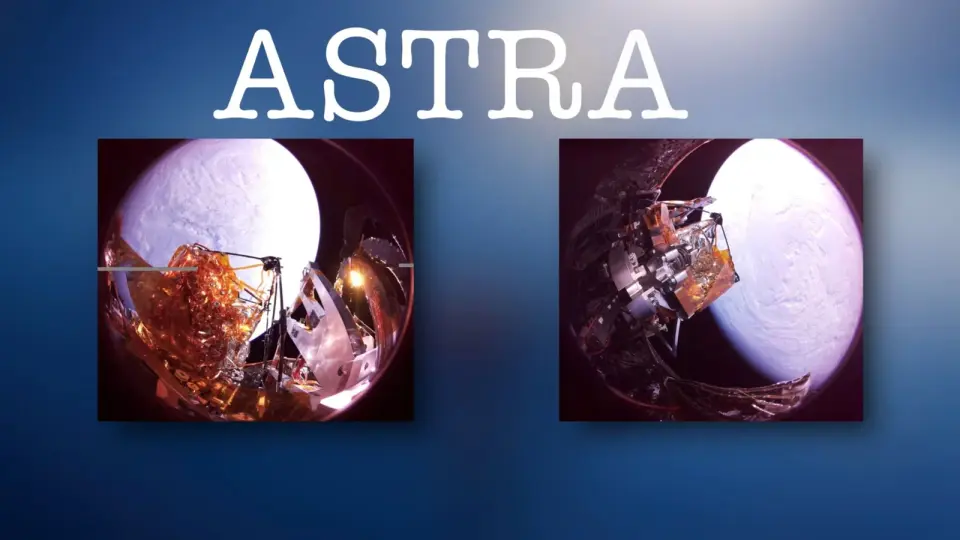
A robotic system developed by Caltech successfully assembled a structural section in low Earth orbit for the first time, marking a milestone in autonomous space construction. The demonstration, part of DARPA’s NOM4D program, proved that large structures can be built from raw materials in orbit rather than being folded or manually assembled by astronauts. Although the mission did not complete the full antenna due to technical challenges, it validated the feasibility of scaling construction to kilometer-sized structures for future telescopes and solar arrays.
Key points
- The Autonomous In-Space Tensioned Reflector Assembly (ASTRA) mission, funded by DARPA, achieved the first autonomous construction of a structure in space.
- The robot assembled a 1.4-meter-wide truss using composite fiber tubes, aluminum joints, and Kapton film, though it only completed one of the planned 11 bays due to time constraints.
- The payload launched on March 30, 2026, aboard SpaceX’s Transporter-16 rideshare mission, hosted by Momentus Inc.’s Vigoride 7 space tug.
- DARPA’s NOM4D program aims to enable the construction of structures hundreds of meters or kilometers in scale, which is currently impossible with traditional launch methods.
- The demonstration validates a new approach where raw materials are shipped to orbit and assembled there, bypassing the size limitations of rocket fairings.
Background
This development follows earlier efforts in space robotics, such as the 2014 3D printing of a faceplate on the International Space Station and NASA’s Archinaut One project, which ended in 2023. While previous missions focused on manufacturing replacement parts or assembling pre-built components, ASTRA represents a shift toward constructing large, complex structures from scratch in orbit. The project is part of DARPA’s broader push to mature space manufacturing technologies, with a second phase involving the University of Illinois Urbana-Champaign testing carbon tube hardening on the ISS later in 2026.
How outlets are covering it
Caltech and DARPA emphasize the success of the proof-of-concept, highlighting that the robot’s ability to assemble a section validates the scalability of the technology for future large-scale structures. DARPA program manager Andrew Detor noted that the approach is similar to 'Tinkertoys' or 'K'Nex,' focusing on solid engineering rather than complex algorithms. In contrast, New Atlas points out that the term 'automated' is somewhat misleading, as engineers on Earth had to intervene frequently due to communication windows limited to 15 minutes a day. They also note that while ASTRA is a milestone, it is not a complete communications dish, and the mission faced significant technical hurdles that prevented the completion of the full antenna. Science Daily highlights the emotional impact on the team, noting that former Caltech postdoctoral scholar Jaden Suh was moved to tears upon seeing the payload launch, underscoring the personal significance of the achievement.
Why it matters
The ability to build large structures in space could revolutionize astronomy, communications, and space-based energy systems. By bypassing the size constraints of rocket fairings, future missions could deploy massive telescopes, radio antennas, and solar arrays that are currently impossible to launch. This capability could also support the growing space economy, with startups raising record funding for megaconstellations and other ambitious projects. The success of ASTRA suggests that the size of future space infrastructure may no longer be dictated by the dimensions of the rockets used to launch its components, opening up new possibilities for exploration and resource utilization in space.
What to watch
DARPA’s NOM4D program will continue with a second phase involving the University of Illinois Urbana-Champaign, which will test a novel approach to composite material processing in space on the International Space Station. This project aims to demonstrate a highly-engineered, space-compatible resin system for energy-efficient polymerization to produce high-strength composite structures. As the NOM4D program winds down over the next few months, it aims to jumpstart ambitious ideas and big investments in space manufacturing and assembly, potentially leading to new classes of systems designed specifically for construction and operation in space.
- A robot just built a structure autonomously in space for the 1st time ever Space
- Caltech robot makes history by building a structure in space Science Daily
- Robot successfully builds space structure in first autonomous construction demo Phys.org
- NOM4D program demonstrates automated in-space assembly darpa.mil
- A robot just built a structure in space for the first time New Atlas
Want the full story? Read the original reporting
Read on Space