
Bern Simulations Suggest Ancient Asteroid Impact Shaped Mars Moon Deimos
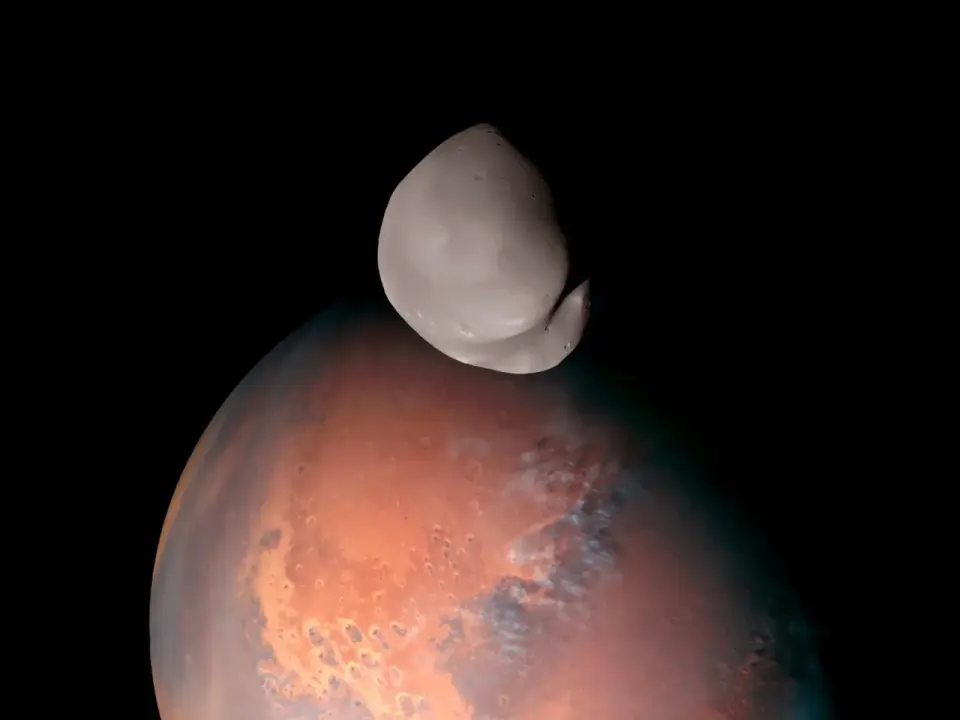
A new study led by the University of Bern suggests that Mars’ moon Deimos was shaped by a massive asteroid impact, creating its thick dust layer and southern depression. Researchers used advanced simulations to model the event, while broader debates continue regarding the origins of Mars’ moons, including theories involving comets or captured asteroids.
Key points
- An international team led by the University of Bern published a study in Nature Astronomy proposing that an asteroid impact shaped Deimos’ surface features.
- The simulations, conducted using the Bern SPH software over approximately 100 runs, identified a scenario where a 320-meter-wide asteroid struck Deimos at a 45-degree angle.
- This impact is believed to have produced the thick, loosely packed regolith layer, estimated to be over 200 meters thick in some areas, and the depression near Deimos’ south pole.
- The study adds to long-standing debates about the origins of Phobos and Deimos, which were discovered in 1877 and remain subjects of speculation regarding whether they are captured asteroids, impact debris, or fragments of a split comet.
- Researchers note that future missions are needed to return samples for definitive analysis, as current theories remain unconfirmed.
Background
Mars’ moons Phobos and Deimos have puzzled scientists since their discovery in 1877, with origins debated for over a century. Recent studies, such as the 2026 findings on Mars’ mantle thermal asymmetry and carbon detection by the Perseverance rover, highlight ongoing efforts to understand Mars’ geological and biological history. The current study on Deimos builds on this broader context of unraveling the Red Planet’s complex past through advanced modeling and remote sensing.
Why it matters
Understanding the formation of Mars’ moons provides critical insights into the early solar system’s dynamics and the processes that shaped planetary bodies. The findings could influence future mission planning, including potential sample-return efforts, and highlight the risks of electrostatic discharges from solar wind interactions for future explorers. This research advances our knowledge of impact mechanics and surface evolution, contributing to the broader goal of determining if Mars once supported life or had conditions favorable for it.
What to watch
Future missions to Mars and its moons are expected to provide definitive answers through sample return and close-up analysis. Researchers will continue refining simulations and models to test alternative theories, such as the comet-split hypothesis, while monitoring the potential hazards of electrostatic discharges for human exploration. The next decade may see increased focus on Deimos and Phobos as key targets for understanding the history of the inner solar system.
Want the full story? Read the original reporting
Read on Futura, le média qui explore le monde