
Dragonfly Rotorcraft Targets July 2028 Launch for Six-Year Titan Voyage
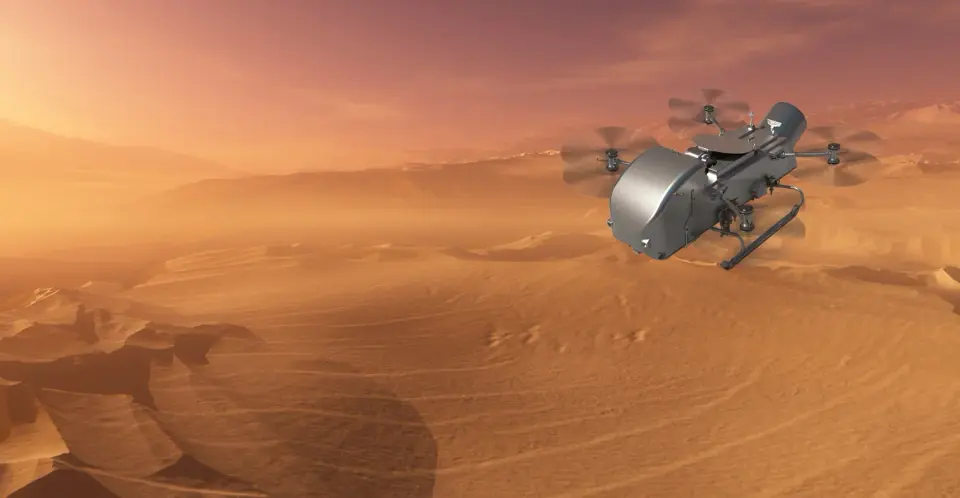
NASA’s Dragonfly mission is scheduled to launch on a SpaceX Falcon Heavy in July 2028, beginning a 6.5-year journey to Saturn’s moon Titan. The nuclear-powered rotorcraft will land in late 2034 to conduct a 3.3-year surface mission, analyzing complex organic chemistry and prebiotic processes. Unlike stationary landers, Dragonfly will fly between 20 to 30 sites, leveraging Titan’s dense atmosphere and low gravity to traverse 115 kilometers. The mission focuses on habitability and chemical evolution rather than direct life detection, with key stops at the Shangri-La dunes and Selk impact crater.
Key points
- Launch is targeted for July 2028 from Kennedy Space Center’s Launch Complex 39A, with a firm-fixed-price contract of $256.6 million awarded to SpaceX in November 2024.
- The spacecraft will undergo a 6.5-year cruise, including an Earth gravity assist, before arriving at Titan in December 2034.
- Dragonfly is an 875-kilogram rotorcraft with eight coaxial rotor pairs, designed to fly autonomously due to the significant radio delay between Earth and Titan.
- The mission will utilize a Multi-Mission Radioisotope Thermoelectric Generator for power and heat, as solar energy is insufficient beneath Titan’s haze.
- Primary scientific goals include analyzing organic molecules via mass spectrometry and gamma-ray spectroscopy, with a focus on the Shangri-La sand sea and Selk crater.
- The total life-cycle cost is estimated at $3.35 billion, with previous delays attributed to funding, pandemic effects, and supply chain issues.
Background
Previous coverage established that Titan possesses a hydrological cycle using methane and ethane, featuring rivers, lakes, and seas, though its surface is composed of water ice. Earlier reports confirmed NASA’s selection of SpaceX for the launch and highlighted the mission’s focus on prebiotic chemistry rather than biological life detection. The 2026 update confirms the spacecraft’s structural testing completion and integration phase, marking a transition from simulation to hardware readiness.
Why it matters
Dragonfly represents the first powered flight on another world, enabling comparative analysis of diverse geological and chemical environments on Titan. Its ability to move between sites provides a broader scientific scope than stationary landers, potentially revealing how prebiotic chemistry progresses in an environment with liquid hydrocarbons. The mission’s success will validate autonomous navigation and survival in extreme cold and dense atmospheric conditions, advancing deep-space exploration capabilities.
What to watch
Dragonfly must complete environmental qualification and radioisotope power integration before the July 2028 launch window. Following launch, the spacecraft will undergo a 6.5-year cruise, with engineers monitoring its health and preparing for atmospheric entry. Upon arrival in late 2034, the rotorcraft will begin its 3.3-year surface mission, conducting flights and sampling at multiple sites, with the first data expected to reach Earth years after the initial launch.
Want the full story? Read the original reporting
Read on Space Daily