
ESA Reveals First Close-Up Images of DART Impact Crater on Asteroid Dimorphos
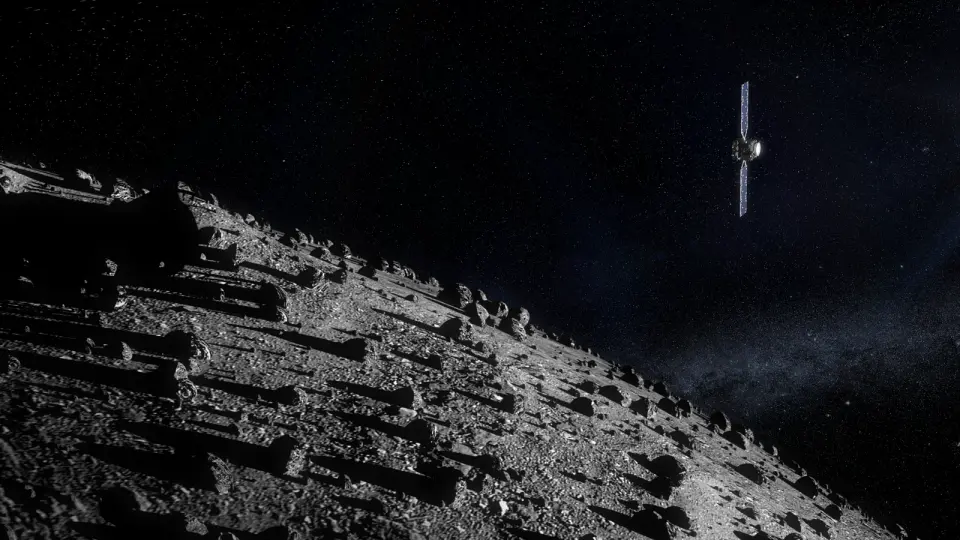
The European Space Agency (ESA) released the first close-up images of the asteroid Dimorphos on Nov. 25, 2026, following the arrival of its Hera probe. The images reveal a massive, stadium-sized crater left by NASA’s 2022 DART impact, which was larger than scientists anticipated. The mission aims to analyze the crater’s size, depth, and surrounding debris to refine planetary defense models. Hera will continue studying the Didymos-Dimorphos system until June 2027, deploying CubeSats to measure the asteroid’s mass and internal structure.
Key points
- ESA’s Hera spacecraft arrived at the Didymos-Dimorphos binary asteroid system in October 2026 after a two-year journey, including a Mars gravity-assist flyby.
- On Nov. 25, 2026, ESA unveiled the first close-up images of Dimorphos, showing a crater nearly as wide as the asteroid’s entire face, a result that surprised scientists.
- The 2022 DART impact shortened Dimorphos’s orbital period by 33 minutes and 15 seconds, exceeding the 73-second success threshold and suggesting the asteroid’s mechanical properties were different than expected.
- Hera’s HyperScout-H camera detected hundreds of orbiting boulders around the system, debris from the DART impact, which the probe must account for during closer approaches.
- Hera will deploy two CubeSats, Juventas and Milani, in January 2027 to study the asteroid’s interior via radar and analyze its composition, with Juventas planned to land on Dimorphos in April 2027.
Background
NASA’s DART mission struck Dimorphos on Sept. 26, 2022, at 6.1 km/s, the first human attempt to alter an asteroid’s trajectory. Ground-based observations confirmed a 33-minute orbital shift but lacked detail to explain the magnitude. ESA’s Hera probe, launched Oct. 7, 2024, was designed to inspect the impact site. Earlier archive coverage noted Hera’s braking maneuvers in October 2026 and its first separate view of Dimorphos on Oct. 18, 2026. The Nov. 25 image release was held at the Museum für Naturkunde in Berlin, with participation from Hera principal investigator Patrick Michel and mission manager Ian Carnelli.
How outlets are covering it
Space.com and ESA emphasized the public livestream release of the images on Nov. 25, 2026, highlighting the historic nature of the first close-up views. BBC focused on the investigative aspect, comparing Hera to an 'Inspector Columbo' at a crash scene, and noted the uncertainty about whether the impact left a crater or reshaped the asteroid. IFLScience stressed the surprise of the crater’s size, quoting Ian Carnelli that it was 'almost the size of the asteroid itself,' and highlighted the unexpected debris field. All sources agreed on the 33-minute orbital shift but differed in emphasis: Space.com and ESA focused on the image release, BBC on the scientific questions, and IFLScience on the unexpected crater and debris.
Why it matters
The images provide the first direct evidence of how a kinetic impactor alters an asteroid’s surface and structure, critical for validating planetary defense strategies. The larger-than-expected deflection and crater size indicate that current models of asteroid mechanical properties may be incomplete, requiring refinement. Understanding the debris field and mass distribution will improve predictions for future deflection missions, ensuring humanity can respond to potential asteroid threats.
What to watch
Hera will continue studying the Didymos-Dimorphos system until June 2027, getting closer to the asteroids and acquiring centimeter-level detail. In January 2027, it will deploy the Juventas CubeSat to study the asteroid’s interior via radar and the Milani CubeSat to analyze its composition. Juventas is planned to land on Dimorphos in April 2027. A new Near-Earth Object (NEO) Surveyor telescope is set to launch in 2027 to track potentially hazardous asteroids, and missions to Apophis are planned for 2029.
- Watch live: Europe unveils 1st close-up views of asteroid Dimorphos after NASA's DART impact Space
- Hera spacecraft investigates damage at asteroid "crash scene" BBC
- We Just Got The First Close-Up Look At The Stadium-Sized Crater Humans Left On An Asteroid IFLScience
- Hera’s Didymos asteroid in eclipse ESA
- Nasa knocked an asteroid off course. New closeup photos may shed light on aftermath The Guardian
Want the full story? Read the original reporting
Read on Space