
ESA’s Hera captures rare asteroid eclipse ahead of Nov. 25 crash-site reveal
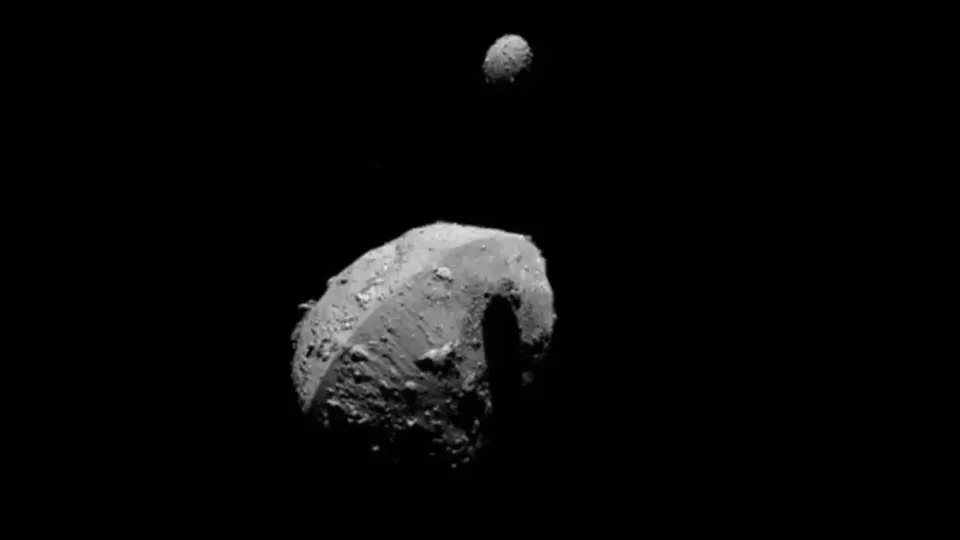
ESA’s Hera spacecraft has transmitted a rare image of a solar eclipse occurring on the Didymos asteroid system, where the smaller moonlet Dimorphos casts a shadow across its larger parent body. This visual was captured while Hera approached the system from 121 million miles away, preceding the mission’s arrival on Nov. 25, 2026. The primary goal of Hera is to investigate the aftermath of NASA’s 2022 DART impact, which successfully altered Dimorphos’s orbit. While the eclipse image highlights the celestial mechanics of the binary system, the mission’s broader objective is to measure the mass and structural changes of Dimorphos to refine future planetary defense strategies. Detailed close-up images and data from the impact site are scheduled for release on Nov. 25.
Key points
- Hera captured an image of Dimorphos casting a shadow on Didymos, creating a solar eclipse in deep space, from a distance of 121 million miles (195 million km).
- The Didymos system consists of the 730-meter-wide Didymos and the 151-meter-wide Dimorphos, which orbits approximately one kilometer away.
- Hera is investigating the aftermath of NASA’s DART mission, which impacted Dimorphos in September 2022 at 6.1 km/s, shortening its orbit by 33 minutes.
- The mission aims to determine if the impact created a crater or reshaped the asteroid, and to measure Dimorphos’s mass to improve deflection models.
- Hera will deploy two small CubeSats to study the impact site up close and eventually land on the asteroid.
- First full close-up images from the mission are scheduled for release on Nov. 25, 2026.
Background
This event follows the 2022 DART mission, which was the first successful test of a kinetic impactor to alter an asteroid’s trajectory. The Didymos system was chosen because it posed no threat to Earth, allowing scientists to test planetary defense techniques safely. Recent archive coverage of other near-Earth objects, such as the temporary minimoon 2026 QQ8 and the asteroid 1998 KY26, underscores the ongoing effort to catalog and understand small bodies in the solar system. The current Hera mission is part of a broader strategy to prepare for potential future threats, including the upcoming 2029 close approach of asteroid Apophis.
How outlets are covering it
Space.com emphasized the visual rarity of the eclipse image, noting it was beamed home from 121 million miles away. BBC News focused on the investigative aspect, comparing Hera to an 'Inspector Columbo' returning to a crash scene to assess damage and determine if the impact left a crater or reshaped the asteroid. ESA highlighted the celestial mechanics, explaining that the eclipse occurs due to the proximity of Dimorphos and the low gravity environment, while also noting the practical difficulty of standing on such a fast-spinning, low-gravity body. Phys.org detailed the technical capabilities of Hera’s instruments, including the TIRI thermal imager and HyperScout H multispectral camera, which allow scientists to analyze surface composition and temperature variations beyond human vision. All sources agree that the mission’s data is critical for validating kinetic impact as a viable planetary defense method.
Why it matters
The success of the DART mission and the subsequent data from Hera are essential for developing reliable planetary defense strategies. Understanding how a kinetic impactor affects an asteroid’s mass, structure, and orbit allows scientists to calculate the necessary force and timing to deflect a potentially hazardous object. This knowledge is crucial for protecting Earth from future impacts, particularly from medium-sized asteroids that could cause significant regional damage. The data from Hera will help refine models used to predict the outcomes of future deflection missions, ensuring that humanity is better prepared to respond to threats from space.
What to watch
ESA will release the first full close-up images from the Hera mission on Nov. 25, 2026, via a livestream. The spacecraft will spend the next year studying Dimorphos and Didymos, deploying two CubeSats for closer inspection and eventually landing on the asteroid. Future missions, including NASA’s Osiris-Apex and the ESA-JAXA Ramses mission, are planned to visit asteroid Apophis in 2029 to study it up close as it passes near Earth. Additionally, a new space telescope, the Near-Earth Object (NEO) Surveyor, is set to launch in 2027 to track potentially hazardous asteroids.
- Double asteroid solar eclipse caught on camera photo of the day for Nov. 24, 2026 Space
- Hera spacecraft investigates damage at asteroid "crash scene" BBC
- Hera’s Didymos asteroid in eclipse ESA
- Hera surveys asteroids with superhuman vision Phys.org
- Hera’s first thermal images of Didymos-Dimorphos reveal cooling hidden from visible cameras The Watchers - Watching the world evolve and transform
Want the full story? Read the original reporting
Read on Space