
Falcon Heavy boosters land after Roman Telescope launch
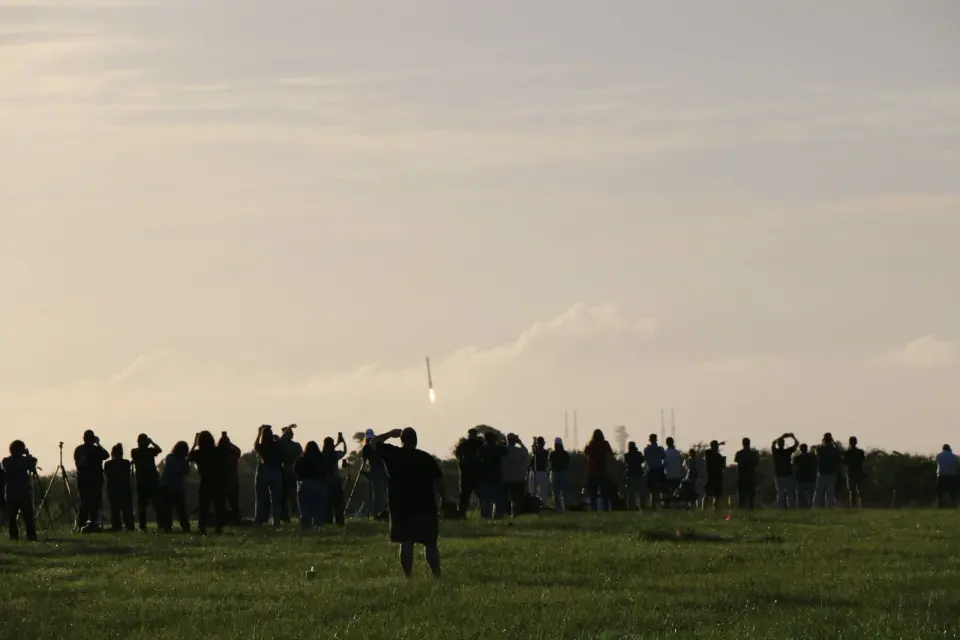
SpaceX's Falcon Heavy successfully launched NASA's Nancy Grace Roman Space Telescope on August 30, 2026. The rocket's two side boosters returned to Earth and landed upright, a feat captured by photographers at Kennedy Space Center. The telescope is now en route to its destination at Lagrange Point 2 to begin a five-year survey of the cosmos.
Key points
- The Nancy Grace Roman Space Telescope launched on August 30, 2026, aboard a SpaceX Falcon Heavy rocket.
- The Falcon Heavy's two side boosters successfully landed upright on Earth after the launch, demonstrating reusable rocket technology.
- The telescope is traveling to an observation point 1.5 million kilometers from Earth, near Lagrange Point 2.
- Roman is equipped with a Wide-Field Instrument and a coronagraph to image exoplanets and survey large areas of the sky.
- The telescope is expected to survey 50 times the sky area Hubble covered in 30 years over its first five years.
Background
NASA's Nancy Grace Roman Space Telescope was launched on August 30, 2026, from Kennedy Space Center. The observatory is designed to study dark energy, dark matter, and exoplanets. It is named after Nancy Grace Roman, NASA's first chief of astronomy. The telescope is expected to operate for five years, collecting 20 petabytes of data.
How outlets are covering it
Space.com highlighted the successful landing of the Falcon Heavy boosters, emphasizing the precision of reusable rocket technology. The Times of India focused on the scientific capabilities of the Roman Space Telescope, noting its ability to survey large areas of the sky and its collaboration with the Vera C Rubin Observatory. General Aviation News provided a photo of the Falcon 9 launch at dawn, but did not provide additional details on the Roman Space Telescope.
Why it matters
The successful launch and booster landing of the Falcon Heavy demonstrate the viability of reusable rocket technology, which could reduce the cost of space exploration. The Roman Space Telescope's advanced instruments will provide unprecedented data on the cosmos, potentially leading to new discoveries in dark energy, dark matter, and exoplanets.
What to watch
The Roman Space Telescope will continue its journey to Lagrange Point 2, where it will begin a 90-day commissioning period. Once operational, it will start its five-year survey of the cosmos, collecting data on dark energy, dark matter, and exoplanets.
- SpaceX rocket taxi returns after Roman Telescope launch | Space photo of the day for Sept. 8, 2026 Space
- An insider's look at the Nancy Grace Roman Space Telescope The Planetary Society
- Half-a-million 4K TV's to view one photo: Why Nasa's new space telescope is special The Times of India
- Roman Space Telescope live updates: NASA begins spacecraft commissioning process Space
- Picture of the Day: Capturing the Falcon 9 Launch at Dawn General Aviation News
Want the full story? Read the original reporting
Read on Space