
Félicette: The Parisian Stray Who Became the First Cat in Space
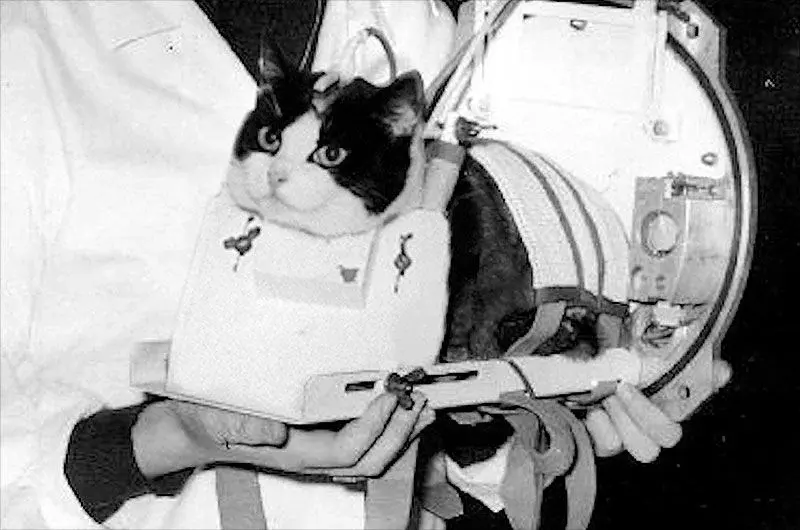
On October 18, 1963, a stray tuxedo cat named Félicette became the first and only feline to travel to space. Launched by France on a Véronique AG1 rocket, she reached an altitude of 130 miles before safely parachuting back to Earth. Although she survived the flight, she was euthanized two months later for scientific study. A subsequent cat launch failed, leading France to shift its animal research focus to monkeys.
Key points
- Félicette, a stray cat from Paris, was selected as a substitute for another cat named Felix who escaped on launch day.
- She was launched on a French Véronique AG1 rocket on October 18, 1963, reaching an altitude of 130 miles above Earth.
- Félicette survived the mission and returned safely via parachute, unlike many other animal astronauts of the era.
- She was euthanized two months after her recovery to allow scientists to study her brain.
- A second cat launched on October 24, 1963, died during its flight, prompting CERMA to switch its research to monkeys.
- Félicette’s legacy was preserved through a crowdfunded effort to erect a statue in her memory.
Background
This event occurred during the Cold War space race, when the U.S. and Soviet Union were primarily launching primates, dogs, and humans. France joined the effort by testing animal tolerance to spaceflight. The archive notes that modern space exploration focuses on long-duration missions, such as Voyager 1’s upcoming one-light-day milestone, and the transition of crewed orbital hubs like Tiangong, highlighting the evolution from animal testing to human and robotic exploration.
Why it matters
Félicette’s flight demonstrated that cats could survive the stresses of spaceflight, contributing to the broader understanding of animal physiology in space. Her story also illustrates the ethical shifts in space exploration, moving from animal testing to human missions and robotic probes. The crowdfunded statue underscores public interest in commemorating historical space milestones, even those involving animals.
What to watch
No new developments are expected regarding Félicette, as her story is a historical event. However, the crowdfunded statue project may continue to raise awareness about her legacy. Future space missions will likely focus on human exploration and robotic probes, as indicated by the archive’s coverage of Voyager 1 and Tiangong.
Want the full story? Read the original reporting
Read on Space