
James Webb Spots Ancient Galaxy Cluster Acting as a Cosmic Magnifier
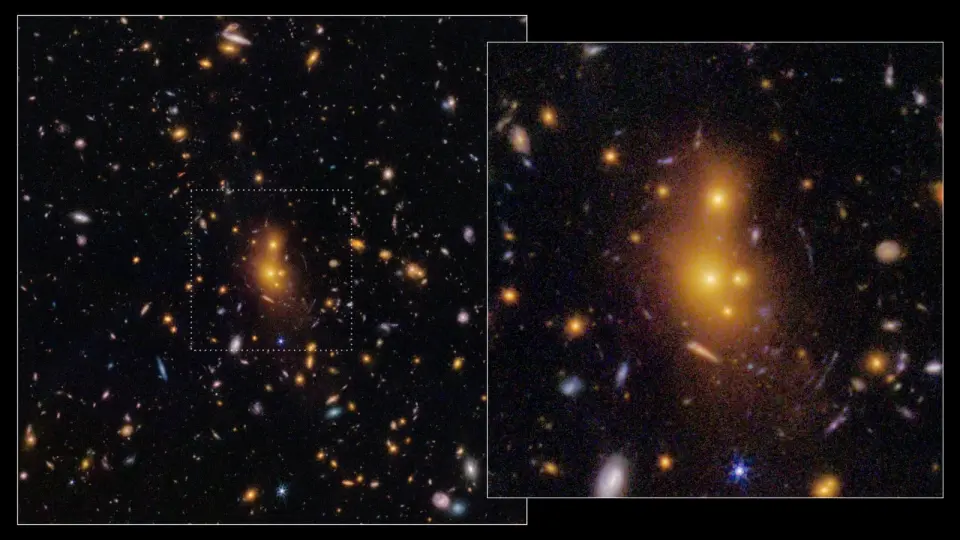
NASA’s James Webb Space Telescope has observed XLSSC 122, a massive galaxy cluster seen as it was about 10.4 billion years ago (roughly 3.4 billion years after the Big Bang). The cluster is unusually evolved, and it serves as a gravitational lens that magnifies distant background galaxies, making XLSSC 122 the most distant cluster observed with strong lensing. This finding could prompt revisions to theories of early structure formation and offers a new way to study dark matter’s distribution. The team presented their results at the 2026 American Astronomical Society meeting, highlighting JWST’s power to probe the distant universe and the potential discovery of many similar lensing clusters in the early cosmos.
- The James Webb Space Telescope peered into one of the universe's oldest galaxy clusters, and scientists can't explain what they saw Space
- The JWST Spies Six Galaxies Becoming One Universe Today
- The James Webb Space Telescope found a spiral galaxy, nicknamed the Big Wheel, that existed just two billion years after the Big Bang — five times more massive than the Milky Way, with a spiral structure our models say couldn't have survived that early Space Daily
- Webb Telescope Finds Giant Galaxy, Black Hole Birth Mirage News
- James Webb Space Telescope Spots Six Galaxies Merging Into One 12 Billion Years Ago Tech Times
Want the full story? Read the original reporting
Read on Space