
JWST Reveals Rare O-Type Star in Carina Nebula’s 'Treasure Chest' Globule
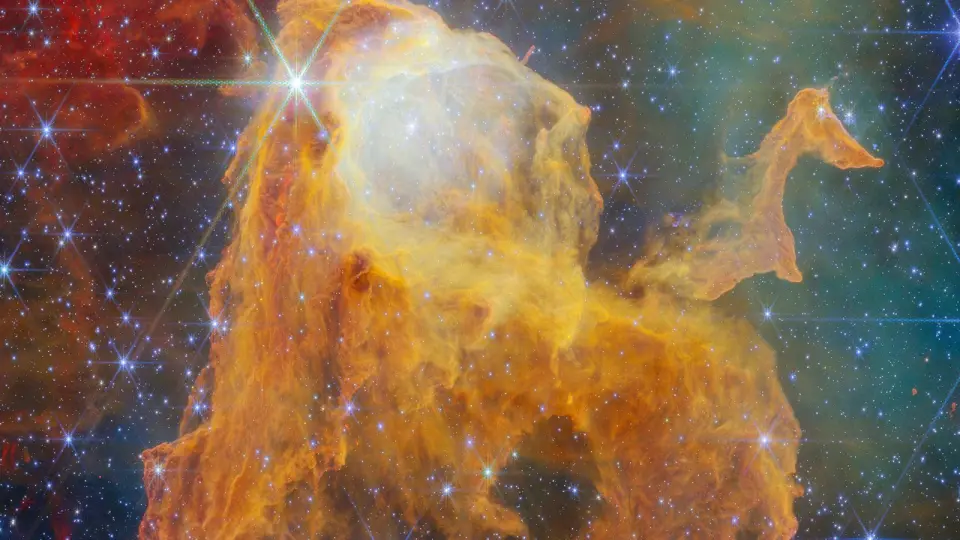
The James Webb Space Telescope has captured a new image of the 'Treasure Chest' cometary globule in the Carina Nebula, revealing a cluster of approximately 70 newborn stars. The most massive of these is a rare O-type star, about 19 times the mass of the Sun. Located 7,500 light-years away, the cluster is estimated to be 1.3 million years old, though earlier estimates suggested it could be as young as 100,000 years. The globule’s distinctive shape is being sculpted by radiation and stellar winds from nearby massive stars, including Eta Carinae and the Trumpler 16 cluster. Over time, this external pressure will disperse the surrounding gas and dust, eventually exposing the hidden stars within.
Key points
- JWST’s Near-Infrared Camera identified about 70 young stars inside the 'Treasure Chest' globule in the Carina Nebula.
- The cluster contains a rare O-type star, approximately 19 times the mass of the Sun, which is extremely bright and short-lived.
- The star cluster is estimated to be around 1.3 million years old, a revision from earlier estimates of 100,000 years.
- The globule’s shape is influenced by radiation and winds from nearby Eta Carinae and the Trumpler 16 star cluster.
- The Treasure Chest is located about 7,500 light-years away in the constellation Carina, within a star-forming region spanning 260 light-years.
Background
The Carina Nebula is one of the Milky Way’s most active star-forming regions, previously featured in JWST’s 2022 'Cosmic Cliffs' image. Recent JWST studies have also refined our understanding of early galaxy formation by revealing more faint stars than previously thought, suggesting that similar processes of star formation and dust dispersion may be common in the early universe. The Treasure Chest globule provides a detailed view of how massive stars sculpt their surroundings, offering insights into the lifecycle of stellar nurseries.
Why it matters
This discovery highlights the role of massive stars in shaping the structure of star-forming regions and the evolution of stellar clusters. The presence of a rare O-type star in such a young cluster provides a snapshot of early stellar evolution, helping astronomers understand how radiation and winds from massive stars disperse surrounding gas and dust, ultimately revealing the stars within. This contributes to broader models of galaxy formation and the lifecycle of stars in the Milky Way.
What to watch
Astronomers expect that the radiation and winds from the stars within the Treasure Chest, combined with external forces from nearby massive stars, will gradually erode the remaining gas and dust. This process will eventually expose the hidden stars, providing a clearer view of the cluster’s composition and evolution. Future observations may refine the age estimates and reveal more about the formation of O-type stars in such environments.
Want the full story? Read the original reporting
Read on Live Science