
JWST spots the universe’s most distant galaxy MoM-z14, challenging early-universe predictions
TL;DR
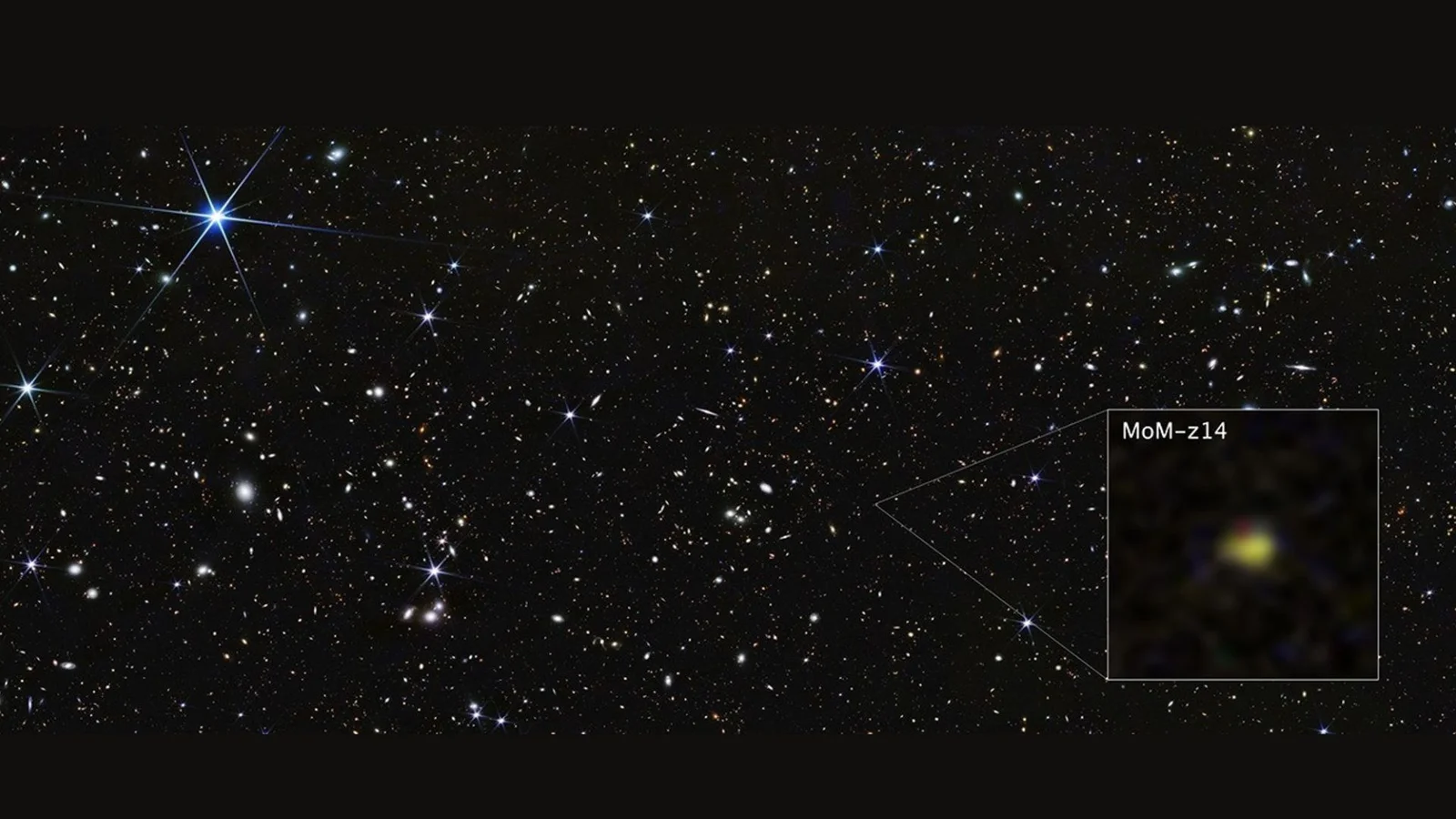
NASA’s James Webb Space Telescope has detected MoM-z14, the farthest galaxy observed to date, about 13.5 billion years back (roughly 280 million years after the Big Bang). The galaxy is brighter, more compact, and chemically enriched than expected for such an early epoch, challenging existing models of early star and galaxy formation and suggesting the early universe may have evolved more rapidly than theories predicted.
Topics:sciencespace#cosmic-dawn#early-universe#high-redshift-galaxy#james-webb-space-telescope#mom-z14#space
- James Webb Space Telescope finds most distant galaxy ever detected: 'It looks nothing like what we predicted' Space
- Astronomers Spot a Huge Cluster of Galaxies Forming Earlier in Cosmic History Than Thought Possible Smithsonian Magazine
- NASA Webb Pushes Boundaries of Observable Universe Closer to Big Bang NASA Science (.gov)
- An X-ray-emitting protocluster at z ≈ 5.7 reveals rapid structure growth Nature
- This ‘baby cluster’ of galaxies in the early universe is mystifying astronomers Scientific American
Want the full story? Read the original reporting
Read on Space