
JWST weighs a distant 6-billion-solar-mass black hole in a 10-billion-light-year galaxy
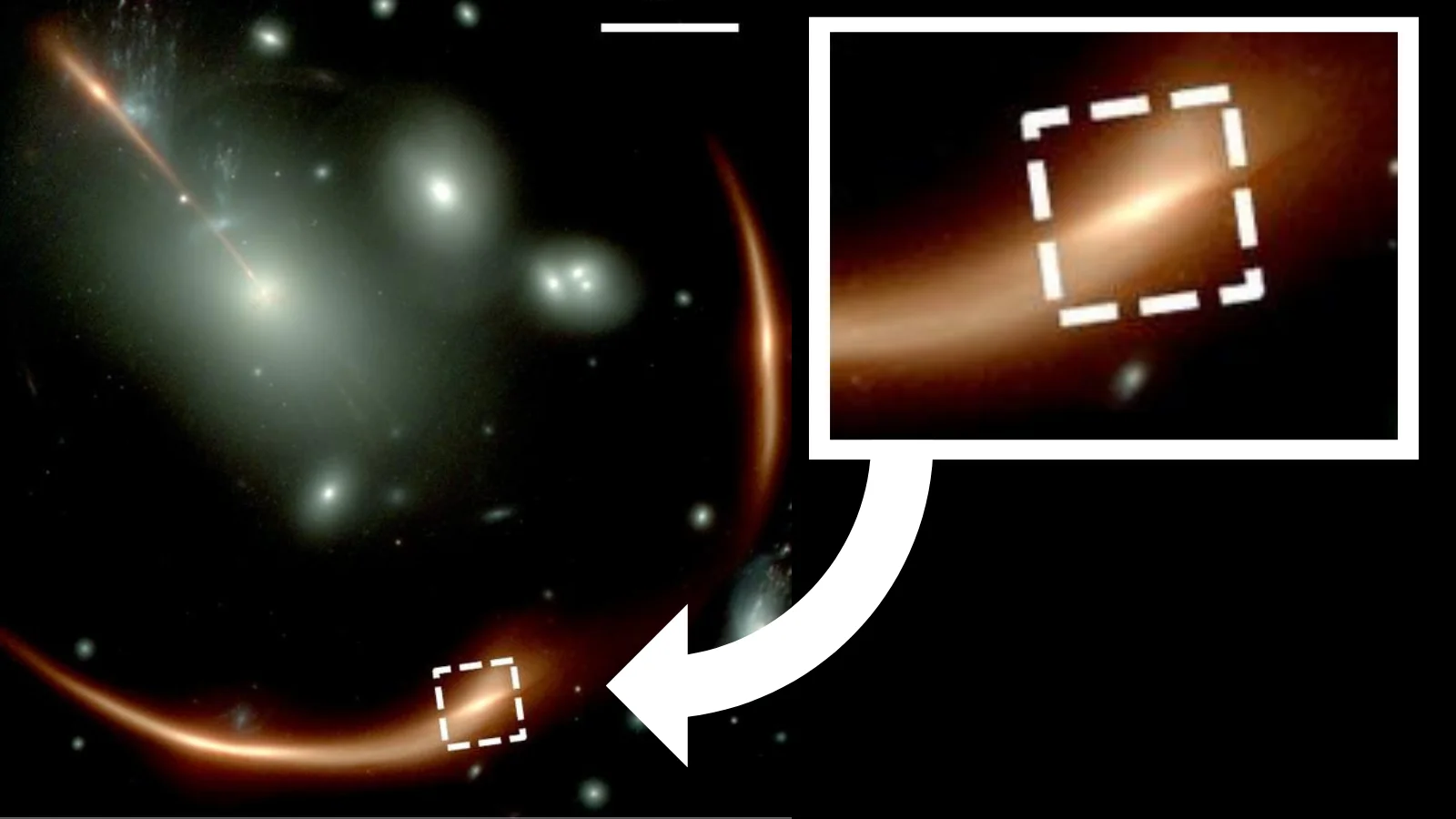
TL;DR Summary
Using the James Webb Space Telescope and gravitational lensing, astronomers tracked the motion of stars at the heart of the galaxy MRG-M0138 (about 10 billion light-years away) to weigh a dormant supermassive black hole of roughly 6 billion solar masses—the most distant black hole weighed by this method. The host galaxy is no longer forming stars, suggesting a past quasar phase that expelled gas and quenched star formation. The study, published in Science, helps chart how black holes and their galaxies grow and influence each other over cosmic time.
Topics:science#black-hole#gravitational-lensing#james-webb-space-telescope#mrg-m0138#space#stellar-dynamics
- James Webb Space Telescope weighs 'sleeping giant' black hole from 10 billion light-years away — and it's 6 billion times our sun's mass Space
- JWST proves that black holes really do come before galaxies Big Think
- James Webb telescope detects most distant dormant black hole, invisible in all wavelengths and weighing as much as 6 billion suns Live Science
- Astronomers Measure The Mass Of A Dormant Black Hole, Our Solar System's Lost Protoplanet, And More Science Stories Yahoo
- It succeeded in observing the mass of a black hole that stopped working about 10 billion years ago f.. 매일경제
Reading Insights
Total Reads
1
Unique Readers
30
Time Saved
71 min
vs 72 min read
Condensed
99%
14,324 → 89 words
Want the full story? Read the original article
Read on Space