
Mars Pathfinder Ends Mission After Battery Failure on Sept. 27, 1997
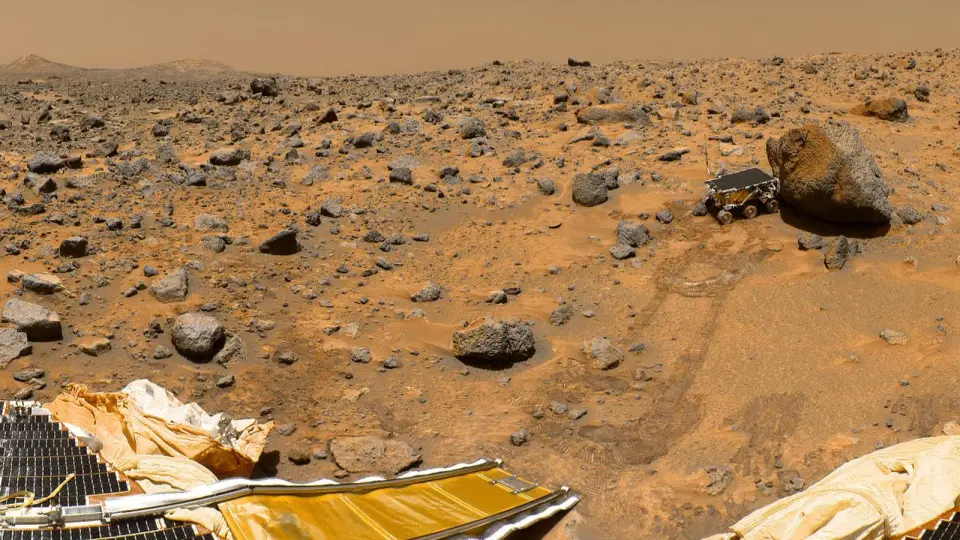
On September 27, 1997, NASA’s Mars Pathfinder lander transmitted its final data to Earth after its battery failed. The mission, which included the first Mars rover, Sojourner, lasted three months, exceeding its one-month goal. NASA attempted to reestablish contact for five months before officially ending the mission. Pathfinder served as a low-cost technology testbed, validating airbag landing systems and rocker-bogie suspension used in later missions like Spirit and Opportunity.
Key points
- Mars Pathfinder sent its last transmission on Sept. 27, 1997, after three months on Mars, exceeding its planned one-month duration.
- The lander’s battery failed, and NASA spent five months trying to reestablish contact before ending the mission.
- Pathfinder included Sojourner, the first rover to operate on Mars, and was led by NASA’s Jet Propulsion Laboratory in Pasadena, California.
- The mission cost $262.3 million in 1997 dollars, a fraction of the cost of earlier Viking landers, and tested technologies like airbag landings and rocker-bogie suspension.
- Technologies developed for Pathfinder were scaled up for the Spirit and Opportunity rovers, which launched in 2004.
Background
This event is part of NASA’s ongoing efforts to explore Mars, following earlier missions like Viking and preceding later rovers. Our archive notes NASA’s Mars Climate Orbiter loss in 1999 due to a unit mix-up, highlighting the importance of precise engineering in Mars missions. Additionally, NASA’s recent $700 million contract with Blue Origin for a Mars Telecommunications Network underscores continued investment in Mars exploration infrastructure.
Why it matters
Mars Pathfinder was a pivotal, low-cost mission that validated key technologies for future Mars exploration, including airbag landings and rover suspension systems. Its success, despite battery failure, demonstrated the viability of NASA’s 'faster, better, cheaper' approach to planetary exploration and paved the way for more ambitious missions like Spirit and Opportunity.
What to watch
No immediate follow-up actions are mentioned in the source. However, the technologies tested by Pathfinder were later used in the Spirit and Opportunity missions, which launched in 2004. NASA continues to invest in Mars exploration, as evidenced by recent contracts like the $700 million Mars Telecommunications Network with Blue Origin.
Want the full story? Read the original reporting
Read on Space