
NASA's SkyFall Mars Helicopters Face 'Shotgun Marriage' with Nuclear Rocket
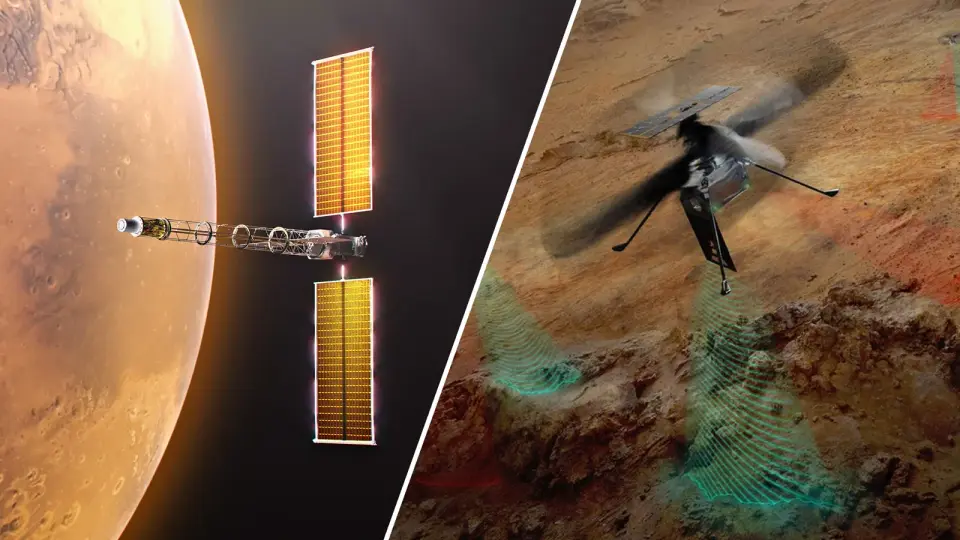
NASA's SkyFall mission, which will deploy three Ingenuity-class helicopters to Mars, is being integrated with the Space Reactor-1 Freedom nuclear spacecraft. While the project has expanded rapidly to over 200 staff, experts debate whether combining the science mission with a technology demo creates management challenges and delays scientific planning.
Key points
- SkyFall will drop three small helicopters from the SR-1 Freedom nuclear rocket during a second Mars approach in Fall 2030, following an initial flyby in 2029.
- The mission aims to fill a 'resolution gap' between orbital and surface data, using ground-penetrating radar to detect subsurface ice and geology.
- Former NASA Mars Program Director Scott Hubbard criticized the pairing as a 'shotgun marriage,' arguing it reverses standard mission design by forcing scientists to fit objectives to the technology demo.
- Project scientist Matthew Golombek noted that if the nuclear craft is not ready, SkyFall can launch on conventional vehicles like a Falcon 9, ensuring mission continuity.
- Potential landing sites include Arcadia Planitia, chosen for its ice deposits and lack of rocks, which is critical for the safe landing of these ultra-light craft.
Background
This development follows earlier reports in October 2026 regarding the acceleration of the SkyFall mission and NASA's broader push for nuclear propulsion to reduce transit times. The mission builds on the success of the Ingenuity helicopter, which demonstrated aerial mobility on Mars. Recent archive coverage also highlighted NASA's testing of fission surface power units and advanced radioisotope generators for deep space missions, providing the technological backdrop for the SR-1 Freedom integration.
Why it matters
The integration of SkyFall with the SR-1 Freedom highlights the tension between technology demonstration and scientific discovery in space exploration. While the nuclear rocket offers potential for faster transit, its readiness is uncertain, and the forced combination may hinder the development of a robust science platform. The mission's success could redefine aerial exploration on Mars, but its management challenges raise questions about the efficiency of combining high-profile initiatives.
What to watch
Two workshops are scheduled for next year to review the science of SkyFall and finalize landing sites. NASA Headquarters will make the final decision on the landing location, balancing scientific value with engineering constraints such as low rock density and slope. Meanwhile, the project continues to expand its team and refine flight paths for the 2030 deployment.
Want the full story? Read the original reporting
Read on Space