
Orbital Congestion Drives New Financial and Robotic Cleanup Strategies
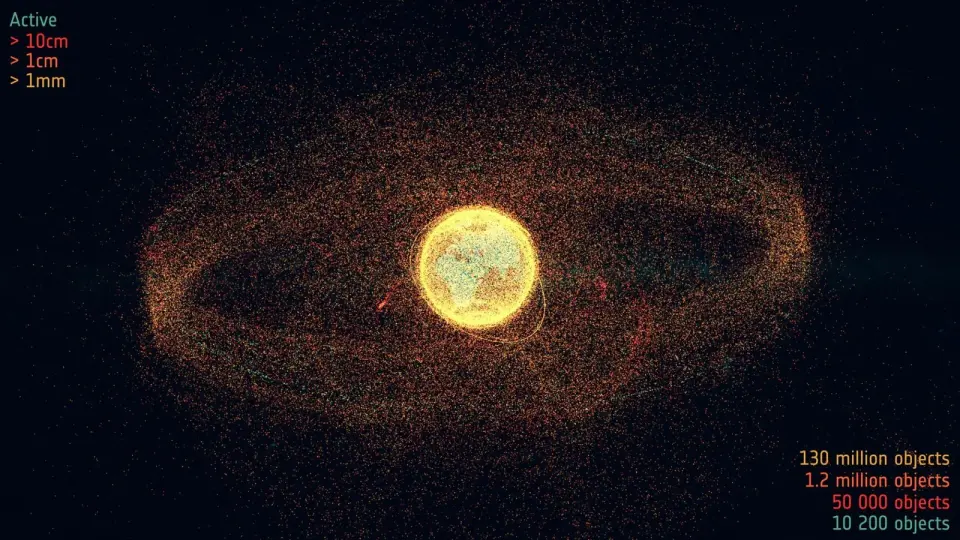
Earth’s orbit faces severe congestion, with active satellites projected to reach 60,000 by 2035 and over 1.2 million debris fragments currently tracked. To mitigate the risk of cascading collisions, stakeholders are implementing financial incentives, such as a proposed $200,000 deposit system, and deploying robotic 'space trucks' for active debris removal. Agencies like ESA and NASA are tightening regulations, while companies like Astroscale and Orbit Fab are advancing in-orbit servicing and refueling technologies to extend satellite lifespans and reduce new waste.
Key points
- Active satellites are expected to rise from 16,000 to 60,000 by 2035, exacerbating orbital congestion.
- Researchers propose a $200,000 deposit system to incentivize satellite deorbiting, potentially reducing abandoned satellites by 18%.
- Commercial firms like Portal Space Systems and Paladin Space are developing robotic vehicles to capture and remove debris in bulk.
- Astroscale’s ADRAS-J2 mission aims to capture a spent rocket casing, demonstrating technology for a circular space economy.
- Regulatory frameworks are tightening, with the U.S. FCC reducing deorbit deadlines to five years and ESA launching a Zero Debris strategy.
Background
Previous coverage highlighted the exponential growth of orbital collisions and the launch of Google’s first orbital AI satellite, signaling a shift toward space-based data centers. The current situation reflects a broader trend where orbital infrastructure is becoming a critical layer for modern life, necessitating sustainable management practices to prevent a Kessler Syndrome cascade.
How outlets are covering it
While Space.com emphasizes the need for a multipronged approach including design standards and active removal, Chosun Ilbo highlights the financial accountability aspect, noting that 60% of fuel-depleted satellites remain in orbit without enforcement. Aerospace Testing International focuses on the technical challenges of testing robotic capture systems in microgravity, whereas Central Florida Public Media underscores the practical limitations of removal, noting that complete debris elimination is unlikely. All sources agree on the urgency of action but differ in emphasis: financial incentives versus technological innovation versus regulatory enforcement.
Why it matters
Orbital sustainability is critical for maintaining the functionality of global infrastructure, including communication, navigation, and data services. Failure to address debris risks could lead to a cascading collision event, rendering large portions of Earth’s orbit unusable for generations. The emerging strategies represent a shift from passive monitoring to active management and financial accountability, ensuring long-term access to space.
What to watch
The U.S. Orbital Sustainability (ORBITS) Act is pending in the Senate, and the ISO is finalizing standards for Space Traffic Coordination. Astroscale’s ADRAS-J2 mission is expected to demonstrate capture capabilities, while Orbit Fab plans in-orbit demonstrations of refueling technology. South Korea is building a Space Situational Awareness center by 2029, and international efforts to standardize debris mitigation practices are accelerating.
- Space debris: Are we on track for true sustainability? (op-ed) Space
- A $200K prelaunch bond for satellites could prevent a space junk disaster in orbit, scientists say Space
- Deposit System and Space Trucks Target Space Debris Reduction 조선일보
- How engineers are testing spacecraft designed to refuel and clean up orbit Aerospace Testing International
- A mission to control space debris and capturing the launch of a new telescope Central Florida Public Media
Want the full story? Read the original reporting
Read on Space