
Powerful winds from early galaxies revealed by Webb
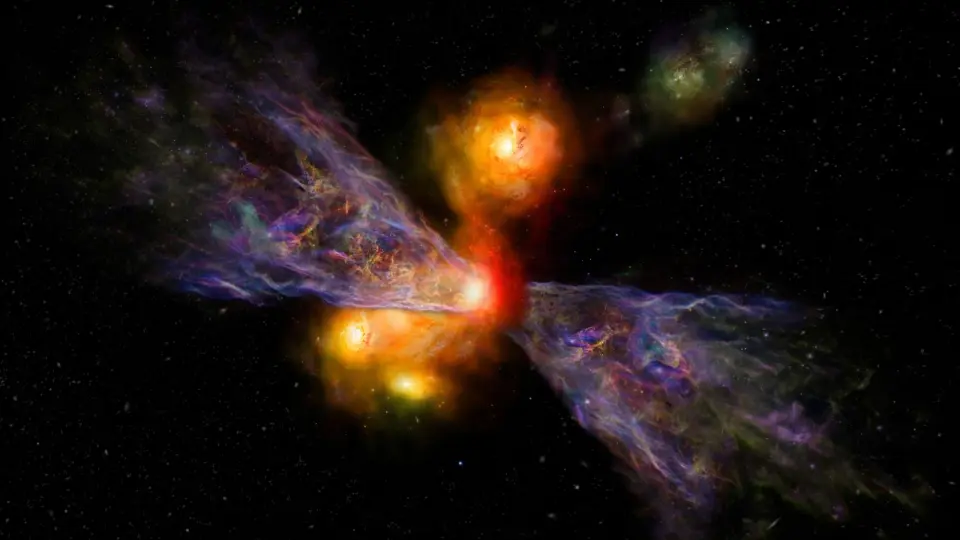
New James Webb Space Telescope observations of the merging galaxy CRISTAL-02, about 1 billion years after the Big Bang, show an enormous gas outflow (~1.5 billion solar masses) and a star-formation rate of ~260 solar masses per year, while gas is being expelled at >500 solar masses per year. The winds, driven by rapid star formation and supernovae (and possibly aided by a black hole), can energize and disperse molecular gas, quenching star formation. If the outflow continues, the galaxy could exhaust its fuel in under 100 million years, offering a window into a widespread mechanism that could explain the abundance of quiescent galaxies in the early universe and inform cosmological simulations—and it hints at similar futures for galaxies like the Milky Way when they collide with Andromeda.
- James Webb telescope detects 'galaxy-killing wind' near the dawn of time Live Science
- Revealing how and when a black hole's mighty winds can squash star formation Phys.org
- ⭐ Why, at a certain mass, do galaxies stop forming stars? Techno-Science.net
- Black hole winds may be robbing giant galaxies of their future stars ScienceDaily
- Black Hole Winds Shut Down Star Formation: XRISM Measures Magnetic Trigger for First Time Tech Times
Want the full story? Read the original reporting
Read on Live Science