
Rubin Observatory’s Early Data Reveals Aquarius IV, a Faint Milky Way Satellite
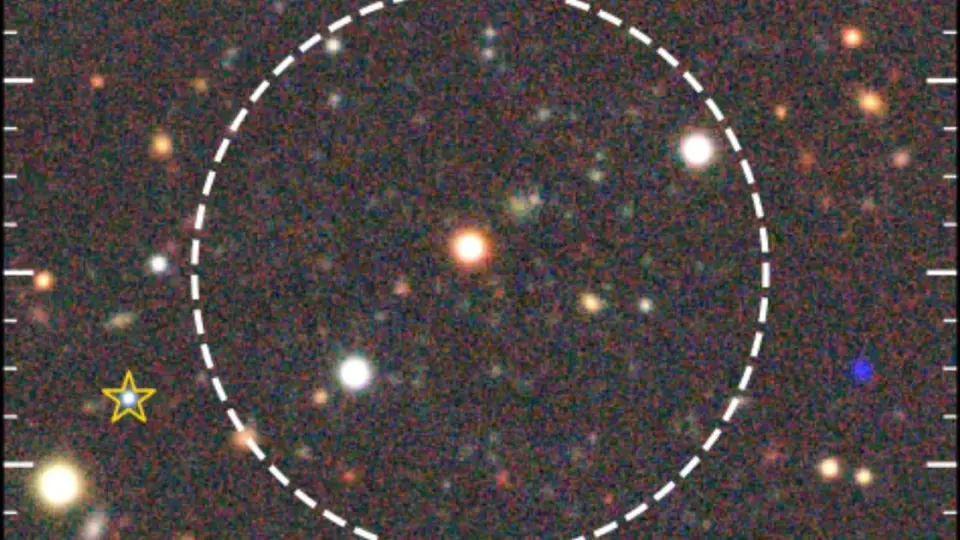
Astronomers using preliminary data from the Vera C. Rubin Observatory have identified Aquarius IV, a newly discovered ultra-faint satellite galaxy orbiting the Milky Way. Located approximately 355,000 light-years away in the galaxy's outer halo, this faint object was detected in the Early Data Preview 2 dataset, which was collected during a testing phase between April 2025 and January 2026. The discovery, led by William Cerny of Yale University, highlights the potential of Rubin’s 3.2-gigapixel camera to uncover faint cosmic structures. While the galaxy’s classification as an ultra-faint dwarf is preliminary, its ancient stars suggest it formed around 13 billion years ago. This finding serves as an early indicator of Rubin’s capability to map the universe’s faintest objects, with scientists expecting to find hundreds more similar galaxies as the 10-year Legacy Survey of Space and Time progresses.
Key points
- Aquarius IV is the first ultra-faint satellite galaxy discovered using preliminary data from the Vera C. Rubin Observatory in Chile.
- The galaxy is located about 355,000 light-years from Earth in the Milky Way's outer halo and has an apparent magnitude of 18.3.
- The discovery was confirmed using archival images from the Dark Energy Camera at the Victor M. Blanco 4-meter Telescope in Chile.
- Researchers believe Aquarius IV is an ultra-faint dwarf galaxy, characterized by low luminosity and high dark matter content, though it could potentially be a large globular cluster.
- The stars in Aquarius IV are metal-poor and estimated to be 13 billion years old, indicating early formation in the universe's history.
- The discovery was made in the Early Data Preview 2 dataset, collected during a testing phase prior to the official start of the 10-year Legacy Survey of Space and Time in June 2026.
Background
This discovery follows recent astronomical findings regarding the Milky Way's structure and composition. In July 2026, astronomers detected the first sugar molecule, erythrulose, in interstellar space near the Milky Way's center, suggesting prebiotic chemistry in space. Additionally, new Gaia measurements and simulations revealed that the Milky Way's halo rotates more slowly than its disk, likely due to ancient mergers and a dramatic 90-degree disk flip. These findings provide a broader context for understanding the galaxy's evolution and the role of faint satellite galaxies in its halo.
Why it matters
The discovery of Aquarius IV demonstrates the Vera C. Rubin Observatory's potential to revolutionize the census of ultra-faint Milky Way satellites. These galaxies are crucial for understanding galaxy formation and dark matter physics, as they are the least luminous and most dark matter-dominated objects known. With Rubin's high-resolution camera, scientists expect to detect similar objects with over 85% efficiency, potentially uncovering hundreds of previously unknown satellites. This capability will help astronomers probe the early universe and the distribution of dark matter, which constitutes roughly 85% of all matter in the universe.
What to watch
Researchers plan to conduct further observations to obtain spectroscopic measurements from more stars in Aquarius IV to confirm its classification as an ultra-faint dwarf galaxy. As the Legacy Survey of Space and Time progresses, the sensitivity of the Rubin Observatory will increase, allowing for the detection of even fainter objects. Scientists anticipate that the survey will reveal many more ultra-faint satellites, significantly expanding the known catalog of Milky Way companions and providing deeper insights into dark matter and galaxy formation.
Want the full story? Read the original reporting
Read on EarthSky