
SpaceX captures Starship upper stage in historic first, though booster fails
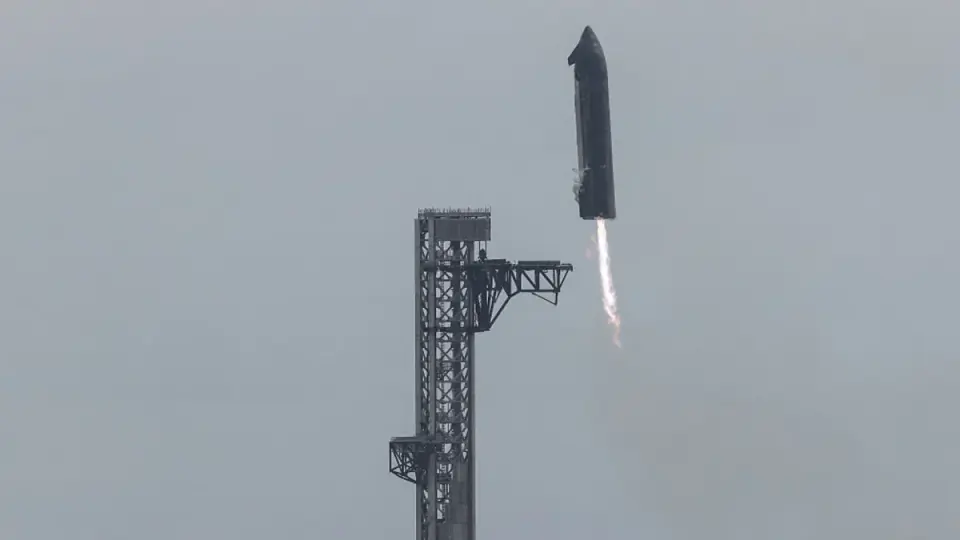
SpaceX successfully caught its Starship upper stage with mechanical arms at its Texas facility on November 14, 2026, marking the first time the vehicle was recovered from orbit. The 15th test flight deployed 26 Starlink satellites and completed 14 orbits, though the Super Heavy booster failed to land and exploded in the Gulf of Mexico.
Key points
- SpaceX achieved the first-ever catch of the Starship upper stage using the 'Mechazilla' tower arms at Starbase, Texas, on November 14, 2026.
- The 15th test flight launched on November 13, 2026, and lasted approximately 22.5 hours, completing 14 orbits around Earth.
- The mission successfully deployed 26 Starlink V3 satellites, adding significant data capacity to SpaceX's orbital constellation.
- The Super Heavy booster failed to return to the launch pad due to a low-fuel alarm and exploded in the Gulf of Mexico after an intentional detonation.
- Elon Musk shared point-of-view footage from the launch tower, highlighting the scale of the catch and the engineering feat involved.
Background
This milestone follows a series of test flights aimed at achieving full reusability for Starship. Previous attempts had successfully caught the Super Heavy booster three times, but this was the first time the upper stage was recovered. The success supports SpaceX's goal of reducing launch costs and increasing mission frequency, which is critical for NASA's Artemis program and future commercial spaceflight.
How outlets are covering it
Mashable and Space.com emphasize the historic nature of the upper stage catch and the visual evidence provided by Musk. Fox Business highlights the broader implications for reusability and notes the failure of the booster catch. Ars Technica focuses on the implications for human spaceflight, noting that while the catch is a step toward reusability, timelines for crewed missions remain uncertain and depend on prioritization over commercial payloads like Starlink.
Why it matters
The successful catch of the Starship upper stage is a critical step toward fully reusable spaceflight, which could significantly reduce launch costs and enable more frequent missions. This success supports NASA's Artemis program and future commercial spaceflight, though the failure of the booster catch indicates that full reusability remains a work in progress.
What to watch
SpaceX will inspect the recovered Starship upper stage to assess its condition after launch, orbit, and reentry. The findings will inform upcoming flights as SpaceX ramps up production and testing. The next mission, USSF-317, is expected to follow soon, continuing the push toward full reusability and higher launch cadence.
- Elon Musk shares POV footage of Starship after the catch Mashable
- Awesome The Atlantic
- When will humans actually fly on Starship? Ars Technica
- SpaceX makes history as Starship spacecraft caught by launch tower for first time Fox Business
- Relive Starship’s historic Flight 15 with our best photos from launch and ‘Mechazilla’ tower catch Space
Want the full story? Read the original reporting
Read on Mashable