
SpaceX Sets New Record with 38-Minute Gap Between Dual Falcon 9 Launches
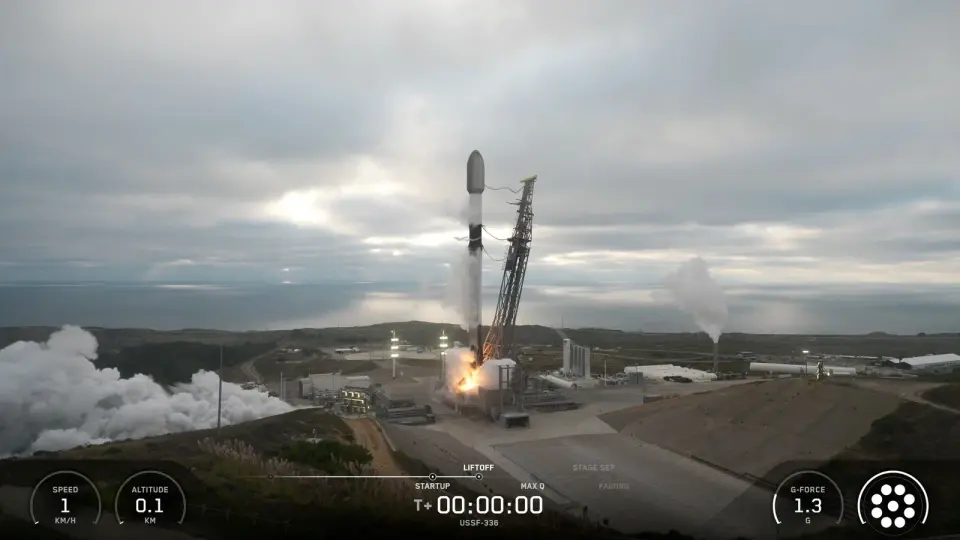
SpaceX achieved a new record for the shortest interval between two orbital launches, flying two Falcon 9 rockets just 38 minutes apart on August 15, 2026. The first liftoff from Cape Canaveral Space Force Station in Florida carried eight Globalstar satellites to low Earth orbit, while the second launched from Vandenberg Space Force Base in California for a classified U.S. Space Force mission. This performance beat the previous record by 27 minutes, demonstrating the company’s ability to operate simultaneously from opposite coasts.
Key points
- The 38-minute gap between launches surpassed the previous record set in August 2024 by 27 minutes.
- The Florida launch occurred at 9:12 p.m. EDT, deploying eight Globalstar satellites over a six-minute span.
- The California launch supported a classified U.S. Space Force mission designated USSF-366.
- The Florida booster was on its 14th flight, having previously supported Crew-10 and multiple Starlink missions.
- SpaceX currently operates a Starlink constellation of nearly 11,000 satellites.
Background
This record follows a trend of increasing launch frequency for SpaceX, which recently completed its 600th flight-proven booster mission in July 2026. The company’s high cadence has significantly impacted the global launch market, with U.S. payload share exceeding 82% in 2024 and per-kilogram costs dropping to approximately $3,225, compared to roughly $9,897 in Europe. These operational efficiencies allow SpaceX to maintain the world’s largest satellite constellation while executing complex dual-coast missions.
How outlets are covering it
Space.com highlights the 38-minute interval as a new benchmark for launch cadence, noting it beat the 2024 record by 27 minutes. WESH provides technical detail on the Florida mission, identifying it as the 14th flight for the first stage booster and confirming the landing at Landing Zone 40. Florida Today focuses on the public impact, noting the nighttime launch produced a sonic boom visible from Jacksonville to West Palm Beach. SpaceX’s official data confirms the Globalstar 2-R Launch 1 mission details, while the broader context shows how this rapid reuse capability pressures competitors in Europe and Asia to develop similar reusable technologies to remain competitive in cost and frequency.
Why it matters
The ability to launch two rockets from opposite coasts within 38 minutes demonstrates SpaceX’s operational maturity and logistical efficiency. This rapid cadence reinforces its dominance in the commercial launch market, driving down costs for satellite operators like Globalstar and the U.S. Space Force. It also highlights the strain on launch infrastructure and the growing complexity of managing high-frequency orbital traffic, which has implications for space debris management and international regulatory frameworks.
What to watch
SpaceX is expected to continue its high launch cadence, with upcoming missions likely including further Starlink deployments and national security launches. The company’s ability to reuse boosters, such as the 14th-flight booster used in this mission, will remain central to its cost-reduction strategy. Analysts will monitor whether this 38-minute gap becomes a new standard for dual-coast operations or if further improvements in turnaround times are achieved in subsequent months.
- New record! SpaceX launches 2 Falcon 9 rockets just 38 minutes apart Space
- USSF-366 Mission SpaceX
- SpaceX Florida rocket launch this weekend. Best places to see liftoff Florida Today
- SpaceX launches Globalstar mission from Florida's Space Coast WESH
- SpaceX launches record-breaking back-to-back Falcon 9 rockets for Globalstar, U.S. Space Force Spaceflight Now
Want the full story? Read the original reporting
Read on Space