
Titan’s 16‑Day Spin Locks Saturn in One Sky
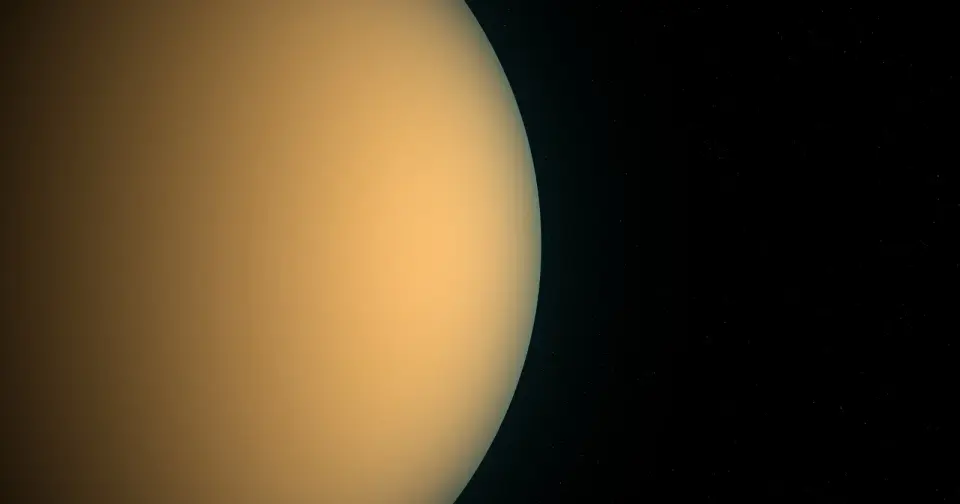
Titan’s day length (~15.95 Earth days) nearly matches its orbit around Saturn, so the moon keeps Saturn in the same direction on one hemisphere and never rises on the other due to tidal locking. A small orbital eccentricity causes a slight wobble (libration) of Saturn’s apparent position in Titan’s sky. Cassini radar data reveal Titan is highly deformable, suggesting a dynamic interior that could host a subsurface ocean or a warm ice layer, though a 2025 reanalysis challenges the global-ocean idea. These findings illuminate Titan’s geophysics and imply that many exoplanets near red dwarfs could be tidally locked, producing hemispheres of permanent daylight or night and dramatically different skies.
- Titan turns so slowly that one rotation takes almost sixteen Earth days, and it is locked in place, showing Saturn the same face forever — so from one side of the moon the ringed planet hangs permanently in the sky, and from the other it is never seen at all Space Daily
- Titan has four seasons much like Earth's, but there is one very strange catch to them: because Saturn takes about 29 years to circle the Sun, a single season on Titan drags on for roughly seven Earth years Space Daily
- How to surf on Saturn’s moon Titan Yahoo
- Titan experiences clouds, rain, rivers and changing seasons like Earth; Saturn’s 29-year journey around the Sun makes each season last more than seven Earth years timesofindia.indiatimes.com
- There is a moon of Saturn where the rain is essentially liquid natural gas, the mountains are made of water frozen so hard it behaves like rock, and the lakes at the north pole contain more combustible fuel than every proven oil and gas reserve on Earth combin ScienceBlog.com
Want the full story? Read the original reporting
Read on Space Daily