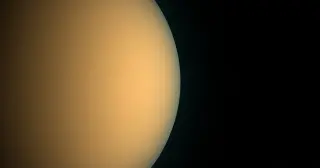
Titan’s 16‑Day Spin Locks Saturn in One Sky
Titan’s day length (~15.95 Earth days) nearly matches its orbit around Saturn, so the moon keeps Saturn in the same direction on one hemisphere and never rises on the other due to tidal locking. A small orbital eccentricity causes a slight wobble (libration) of Saturn’s apparent position in Titan’s sky. Cassini radar data reveal Titan is highly deformable, suggesting a dynamic interior that could host a subsurface ocean or a warm ice layer, though a 2025 reanalysis challenges the global-ocean idea. These findings illuminate Titan’s geophysics and imply that many exoplanets near red dwarfs could be tidally locked, producing hemispheres of permanent daylight or night and dramatically different skies.