
Voskhod 1: The 1964 Soviet Mission That Packed Three Cosmonauts Into a Single-Person Craft
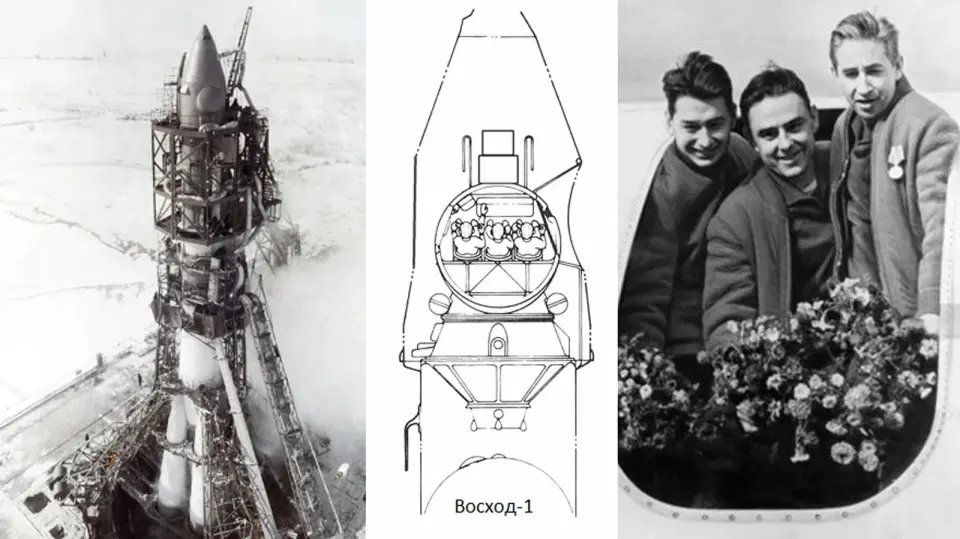
On October 12, 1964, the Soviet Union launched Voskhod 1, the first spacecraft to carry multiple humans into orbit. The mission featured a three-person crew—commander Vladimir Komarov, engineer Konstantin Feoktistov, and doctor Boris Yegorov—who flew without spacesuits due to the cramped cabin. This historic 24-hour flight marked a significant milestone in the Cold War space race, demonstrating Soviet capability to transport multiple crew members ahead of the US Gemini program.
Key points
- Voskhod 1 was the first multi-person crewed spaceflight, launching on October 12, 1964.
- The spacecraft carried three cosmonauts: Vladimir Komarov, Konstantin Feoktistov, and Boris Yegorov.
- Due to the small size of the Voskhod capsule, the crew did not wear spacesuits during launch and landing.
- The mission was a 24-hour orbital flight that included experiments on liquids and gases in microgravity.
- The launch was driven by political pressure from Soviet leader Nikita Khrushchev to outpace the US Gemini program.
Background
This event occurred during the intense Cold War space race, following the launch of Sputnik 1 in 1957 and Yuri Gagarin’s first human spaceflight in 1961. While the US was developing the two-person Gemini spacecraft, the Soviet Union sought to demonstrate superior capability by cramming three people into a vehicle originally designed for one. This historical milestone contrasts with modern multi-crew missions like the recent Crew-13 launch to the International Space Station, which utilized larger spacecraft capable of accommodating four astronauts with full safety equipment.
Why it matters
Voskhod 1 demonstrated the Soviet Union's ability to push the boundaries of human spaceflight technology, even at the cost of crew safety, by eliminating spacesuits to fit a larger team. This achievement highlighted the competitive nature of the space race and set a precedent for multi-crew missions, influencing the trajectory of space exploration in the decades that followed.
What to watch
No future developments are associated with this historical event. The mission concluded with the safe return of the crew after 24 hours in orbit.
Want the full story? Read the original reporting
Read on Space