
Webb uncovers the Big Wheel—a massive spiral galaxy just 2 billion years after the Big Bang
TL;DR
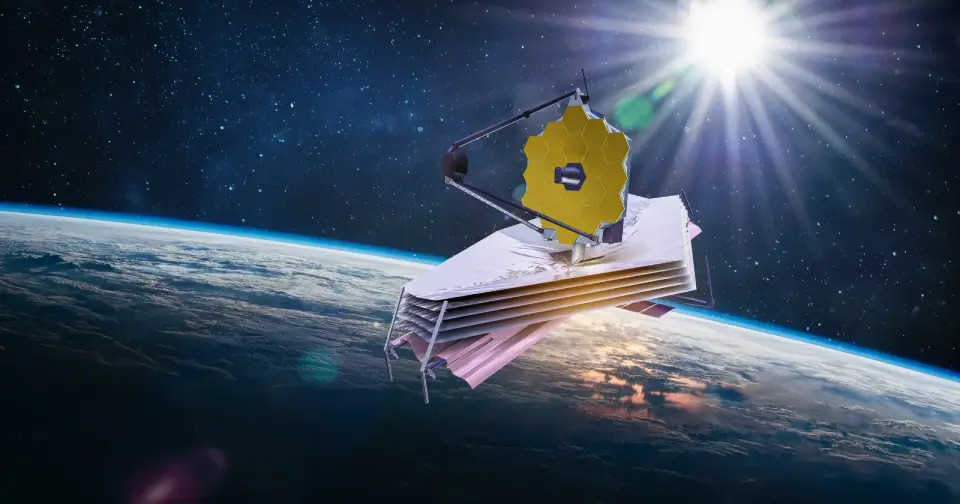
NASA’s James Webb Space Telescope reveals a giant, rotating spiral disk galaxy nicknamed the Big Wheel at redshift 3.245, about two billion years after the Big Bang. With a stellar mass around 3.7×10^11 solar masses and a disk extending ~30 kiloparsecs, it rivals the largest nearby spirals and remains unusually ordered for its epoch, challenging standard galaxy-formation models. The kinematic data confirm rotation, and the dense environment may have aided rapid growth, suggesting multiple pathways for early disk formation and that the early universe hosted more complex structures than once thought.
Topics:sciencespace#early-universe#galaxy-formation-models#giant-disk-galaxy#james-webb-space-telescope#space#spiral-structure
- The James Webb Space Telescope found a spiral galaxy, nicknamed the Big Wheel, that existed just two billion years after the Big Bang — five times more massive than the Milky Way, with a spiral structure our models say couldn't have survived that early Space Daily
- James Webb Space Telescope catches 6 galaxies merging into one of the largest galaxies in the universe Space
- The JWST Spies Six Galaxies Becoming One Universe Today
- JWST found a galaxy cluster 10 billion years old that shouldn’t be this dense Martin Cid Magazine
- James Webb spots the birth of a giant galaxy and a supermassive black hole Universiteit Leiden
Want the full story? Read the original reporting
Read on Space Daily