
JWST's 'Saguaro' Galaxy Image Offers New Clues to the 'Little Red Dots' Mystery
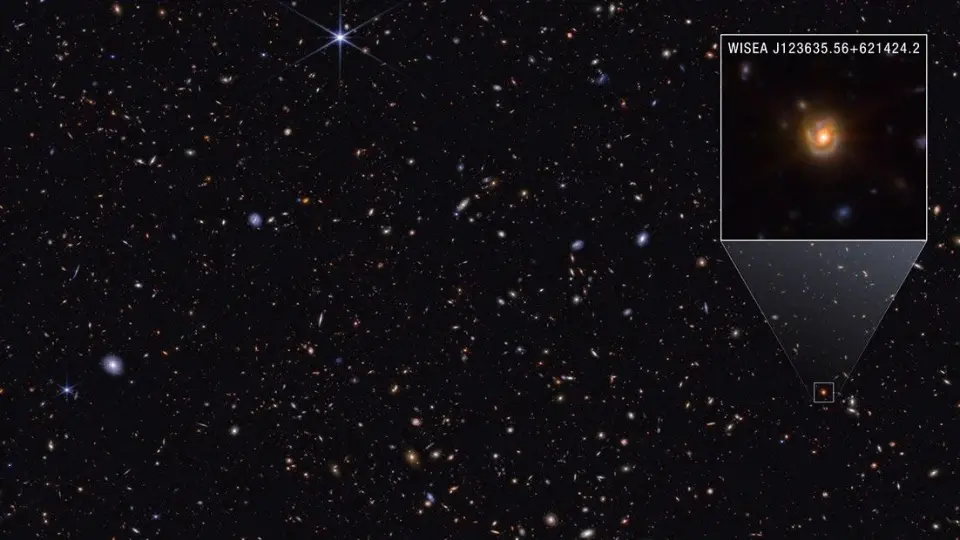
A new James Webb Space Telescope (JWST) image of the galaxy nicknamed 'Saguaro' may help explain the 'Little Red Dots' (LRDs), a mysterious class of compact, bright infrared objects appearing roughly 600 million years after the Big Bang. While earlier theories suggested LRDs were dust-enshrouded black holes or active galactic nuclei, recent models propose they could be supermassive stars up to 100,000 times the mass of the Sun. These hypothetical stars would eject nitrogen-rich gas, matching LRD spectra, and eventually collapse into seeds for supermassive black holes. The Saguaro image, showing a bright infrared core with obscured activity, supports the idea that LRDs are a developmental phase in galaxy evolution rather than a distinct object class.
Key points
- JWST has identified over 300 'Little Red Dots' (LRDs) appearing between 600 million and 1.5 billion years after the Big Bang.
- LRDs are compact, extremely bright, and emit a unique combination of red and ultraviolet light not seen in typical galaxies.
- A new model by astrophysicist Devesh Nandal suggests LRDs are supermassive stars (100,000–1,000,000 solar masses) surrounded by thick gas envelopes.
- These supermassive stars would eject nitrogen-rich shells, matching the chemical signatures observed in LRD spectra.
- The 'Saguaro' galaxy (WISEA J123635.56+621424.2) shows a bright infrared core with faint X-rays, suggesting LRDs evolve into mature galaxies.
- Alternative theories include 'quasi-stars' (light black holes in gas envelopes) and dust-enshrouded active galactic nuclei (AGN).
Background
Our archive from August 2026 noted that LRDs might represent a developmental phase in galaxies with growing supermassive black holes, with the 'Saguaro' galaxy cited as a key example. Earlier coverage also highlighted the possibility of supermassive stars up to 100,000 solar masses and the 'quasi-star' theory, which posits a light black hole embedded in dense gas. The July 2026 reports suggested LRDs could be precursors to globular clusters, linking early-universe observations to mature stellar systems.
How outlets are covering it
Live Science emphasizes the 'Saguaro' image as a potential solution to the LRD mystery, highlighting its role in galaxy evolution. Futura focuses on the supermassive star hypothesis, noting that Nandal's model is the first to simultaneously explain LRD spectra, morphology, and chemical signatures. WIRED provides a broader context, discussing how JWST has challenged existing theories of black hole growth and galaxy formation, with researchers like Charlotte Mason exploring whether LRDs are black holes cocooned in gas or something else. The outlets differ in emphasis: Live Science and Futura focus on specific models (galaxy evolution and supermassive stars), while WIRED highlights the broader impact of JWST on cosmology and the diversity of early galaxies.
Why it matters
Resolving the LRD mystery could redefine our understanding of the early universe, including the formation of supermassive black holes and the first galaxies. If LRDs are indeed supermassive stars, it would explain how black hole seeds formed rapidly and how galaxies evolved from compact, bright objects to mature structures like the Milky Way. This has implications for cosmology, astrophysics, and the origin of elements in the universe.
What to watch
Researchers will continue analyzing JWST data, including spectra from LRDs and the 'Saguaro' galaxy, to test the supermassive star and quasi-star models. Future observations may reveal whether LRDs evolve into mature galaxies or collapse into black holes. Improved simulations and data from JWST's Mid-Infrared Instrument (MIRI) will help clarify the diversity of early galaxies and the role of massive stars in the early universe.
- New James Webb telescope image may reveal the true identity of 'little red dots' — Space photo of the week Live Science
- Red dots in space: could stars 100,000 times heavier than the Sun exist? Futura, le média qui explore le monde
- Inside the mystery of the James Webb Space Telescope's little red dots — and how they might be evolving Space
- 'Little red dots' may be pulsating monster stars that created early-universe black holes Phys.org
- The James Webb Telescope Is Changing Astronomers’ Understanding of the Ancient Cosmos WIRED
Want the full story? Read the original reporting
Read on Live Science