
Beijing Team Builds 23-Gram Goggles That Render Infrared as Full Color
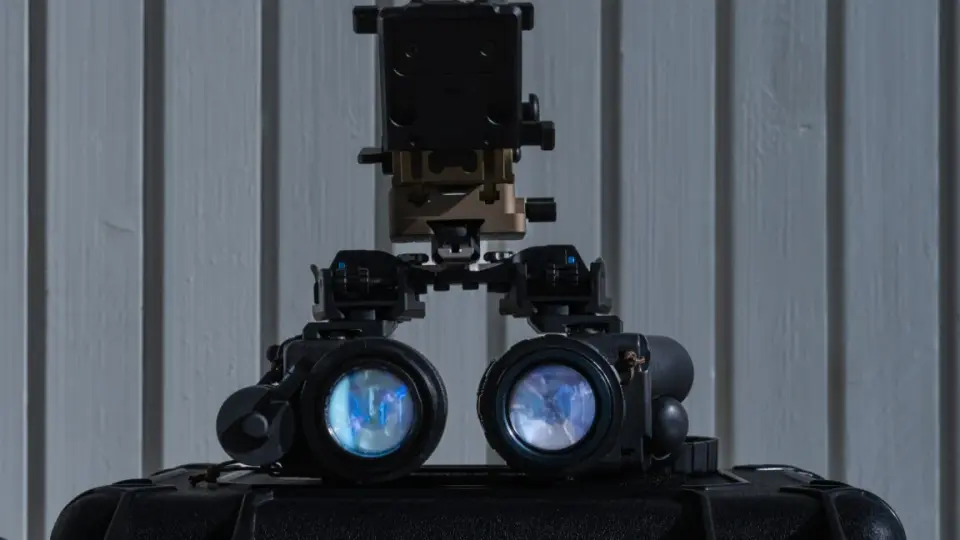
Researchers at the Beijing Institute of Technology have developed a lightweight, semi-transparent eyeglass that converts infrared light into a full-color visible image. Unlike standard night-vision devices that display monochrome green brightness, this prototype uses mercury telluride colloidal quantum dots and a dual-layer OLED to map infrared wavelength and intensity to distinct hues. The 23-gram device, published in Science Advances, demonstrated the ability to trigger visual responses in mice and human volunteers, though it currently requires external power and has not been tested in complex real-world environments.
Key points
- The device translates infrared wavelengths into visible colors by using quantum dots to generate charge carriers based on photon energy, rather than just brightness.
- A dual-layer OLED with a 0.82 electron-volt energy barrier separates red and cyan emissions, allowing the system to encode both wavelength and intensity information.
- The prototype weighs 23 grams and has an active viewing area of 3.57 square centimeters, allowing it to function as an augmented-reality overlay or an immersive infrared-only display.
- Tests showed that infrared light processed by the device triggered electroencephalogram responses in mice and electroretinogram responses in human volunteers, while unprocessed infrared produced no response.
- The technology currently requires an external power supply and has only been tested against calibrated blackbody sources and high-contrast patterns, not complex real-world scenes.
Background
This development builds on the fundamental limitation of human biology, where infrared photons lack the energy to trigger retinal signaling pathways. While previous archive coverage noted that animals like dogs perceive color through a limited spectrum of cones, this new technology aims to bypass biological constraints entirely by using synthetic materials to expand the visible spectrum for humans. It represents a significant step beyond traditional monochrome night-vision goggles, which rely on brightness modulation rather than hue differentiation.
Why it matters
This technology could revolutionize fields requiring thermal or infrared observation, such as search and rescue, military operations, and medical diagnostics. By leveraging the human eye's superior sensitivity to hue differences over brightness, the device promises to provide significantly more detailed information than current monochrome systems. If the challenges of power consumption and biocompatibility are resolved, it could lead to the development of implantable visual prosthetics that allow humans to perceive the infrared spectrum naturally.
What to watch
Researchers must now address the limitations of the current prototype, including the need for an external power supply and the lack of testing in complex, multi-wavelength real-world environments. Future work will likely focus on improving the device's efficiency, ensuring the biocompatibility of the mercury telluride components for potential implantation, and validating color readability in uncontrolled settings. The team also needs to determine if the device can be miniaturized further to become a passive lens rather than a powered display.
Want the full story? Read the original reporting
Read on Ars Technica