
Global CRISPR Database Reveals Complex Viral Targeting Dynamics
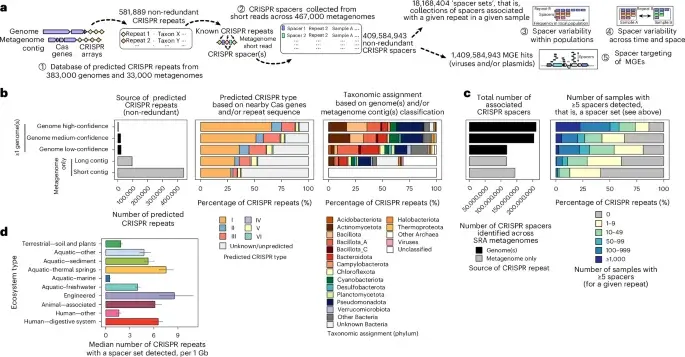
Researchers have constructed the largest global database of CRISPR spacers, comprising 794 million entries from 367,609 metagenomes. This analysis reveals that while spacers are highly variable, those targeting known viruses show higher prevalence and conservation, suggesting positive selection. The study also indicates that phage genomes can enter non-host cells, complicating the distinction between CRISPR targeting and direct virus-host interactions.
Key points
- A new computational pipeline, SpacerExtractor, identified 794 million CRISPR spacers across 367,609 public metagenomes, linking 41 million spacers to 2.5 million viruses and plasmids.
- Spacers matching known viruses are more prevalent and conserved than general spacers, indicating strong positive selection pressure associated with phage defense.
- The data suggests recurrent entry of phage genomes into non-host microbial cells, blurring the lines between specific CRISPR targeting and broader virus-host interactions.
- Spacer sets show high turnover, with 67% of spacers being singletons, but common spacers are shared across population members, reflecting a mix of rare and stable genetic memories.
- CRISPR repeat detection was most frequent in wastewater, bioreactors, and hot springs, while marine samples showed lower detection rates, likely due to differences in community complexity.
Background
This study builds on previous findings that CRISPR-Cas systems are present in approximately 40% of bacterial and 85% of archaeal genomes. Earlier research highlighted the role of CRISPR in microbial immunity but lacked a global scale view of spacer diversity. Recent advancements in gene editing tools, such as PASTE and evoCAST, have expanded beyond traditional CRISPR-Cas9 limitations, but this metagenomic analysis focuses on natural, wild-type CRISPR dynamics rather than engineered applications. The findings provide a baseline for understanding how mobile genetic elements shape microbial evolution across diverse ecosystems.
Why it matters
Understanding the global diversity and activity of CRISPR spacers is crucial for predicting microbial evolution and designing antimicrobial therapies. The discovery that phage genomes can enter non-host cells suggests that CRISPR systems may target genetic elements beyond direct pathogens, influencing strain-level diversification. This knowledge aids in developing more effective bioreactors and wastewater treatment systems, where CRISPR activity is high, and provides insights into the ecological drivers of microbiome stability and change.
What to watch
Researchers will likely use this global database to refine models of microbial immune responses and explore the functional roles of spacers in non-host interactions. The availability of the SpacerExtractor tool and the public database at spacers.jgi.doe.gov will enable further studies on specific ecosystems, potentially leading to new strategies for controlling viral outbreaks in microbiomes and improving industrial microbial processes.
Want the full story? Read the original reporting
Read on Nature