
JWST Reveals Three Active Black Holes in Ancient Galaxy J0148-4214
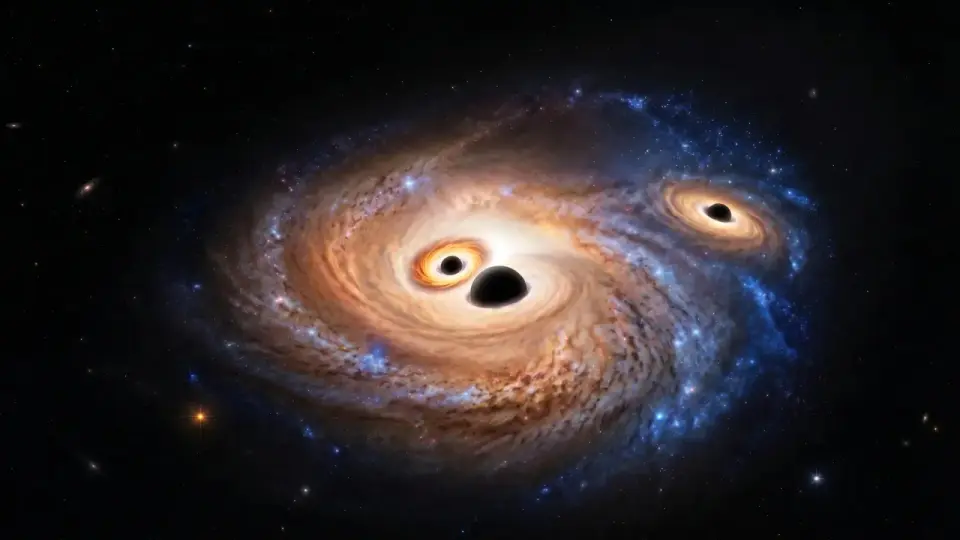
Astronomers using the James Webb Space Telescope have identified three actively feeding supermassive black holes within the galaxy J0148-4214, located 12.5 billion light-years away. This discovery, published in Astronomy, provides a rare snapshot of the universe just 1.2 billion years after the Big Bang. The finding challenges existing models of black hole growth and offers insights into how massive black holes formed and merged during the cosmos's infancy.
Key points
- The galaxy J0148-4214, at a redshift of z=5.02, contains three active black holes with masses of approximately 80 million, 600,000, and 2 million solar masses.
- Two central black holes are separated by only 620 light-years and are expected to merge within a few hundred million years, while the third is located 5,500 light-years from the center.
- The 600,000-solar-mass black hole is accreting matter at a rate exceeding the theoretical Eddington limit, suggesting rapid growth mechanisms in the early universe.
- The discovery was made using JWST’s Near Infrared Spectrograph in integral field spectroscopy mode, which allowed researchers to distinguish between overlapping spectral signatures.
- The third black hole may be a remnant of a previous merger ejected by gravitational recoil, or it may be migrating toward the galaxy's center.
Background
This discovery builds on recent findings regarding the rapid growth of black holes in the early universe. In January 2026, simulations suggested that chaotic early galaxies facilitated supercharged black hole growth. Additionally, September 2025 research highlighted 'rogue' black holes ejected from galaxies during mergers, which may preserve galactic histories. The current finding of multiple black holes in a single ancient galaxy supports the theory that mergers were a primary driver for creating massive black holes shortly after the Big Bang.
Why it matters
Identifying three active black holes in a single galaxy from the dawn of time provides critical evidence for how supermassive black holes grew so rapidly in the early universe. It validates the role of galaxy mergers in bringing black holes together and offers a potential explanation for black holes exceeding standard growth limits. This discovery also demonstrates the power of JWST’s spectroscopic capabilities to uncover hidden structures in distant galaxies, potentially leading to the detection of similar systems elsewhere.
What to watch
Researchers expect the two central black holes to merge within a few hundred million years, producing an even more massive black hole. Future gravitational wave observatories may detect the signals from such mergers. Additionally, astronomers plan to search for other distant galaxies with multiple black holes to better understand the prevalence of this phenomenon in the early universe.
Want the full story? Read the original reporting
Read on Science Daily