
JWST Identifies First 'Black Hole Star,' Solving Mystery of Little Red Dots
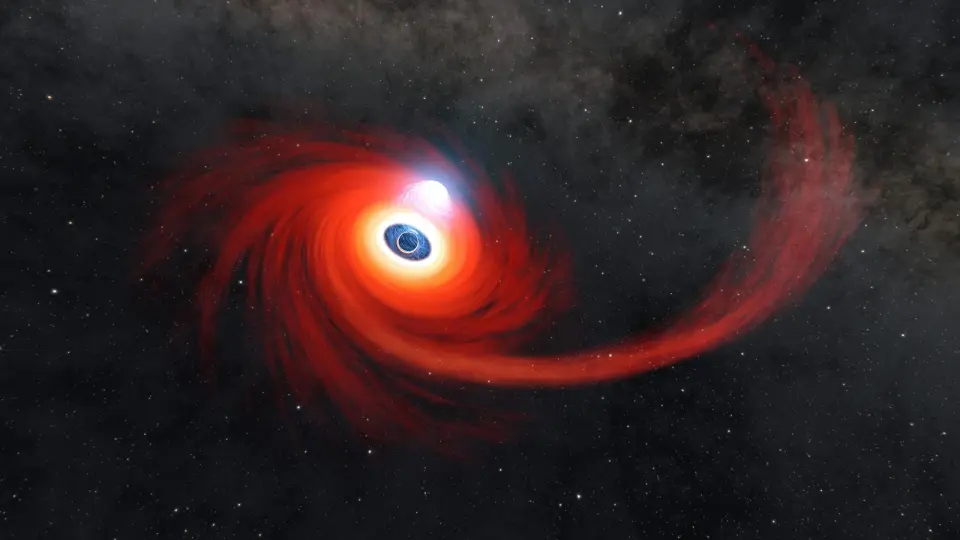
Astronomers have identified MoM-BH*-1, the most distant 'black hole star' ever found, existing just 660 million years after the Big Bang. This object, discovered via the James Webb Space Telescope, is a supermassive black hole enveloped in dense gas that radiates like a star. Its discovery provides a key explanation for the 'little red dots' observed in early universe images, suggesting these are nascent black holes rather than dust-obscured stars.
Key points
- MoM-BH*-1 is located in the constellation Cetus, approximately 30 billion light-years away, and dates to 660 million years after the Big Bang.
- The object emits 100 billion times more energy than any known star, indicating a central black hole of roughly 100,000 solar masses.
- It is surrounded by a dense, dust-free gas envelope the size of the solar system, which creates a strong Balmer break, making it appear red.
- The discovery was made during the 'Mirage or Miracle' survey, which targeted high-redshift sources that could be either amazing discoveries or interlopers.
- This finding suggests that 'little red dots' in JWST images are likely black hole stars, which may be the seeds of modern supermassive black holes.
Background
Previous archive entries from July and August 2026 noted the discovery of 'little red dots' in JWST images, with theories ranging from quasi-stars to dense gas envelopes around black holes. The current report confirms the 'black hole star' model with the first definitive example, MoM-BH*-1, resolving earlier debates about the nature of these compact red sources.
How outlets are covering it
Space.com and The Guardian emphasize the object's role in solving the 'little red dot' mystery, highlighting its distance and energy output. MIT News focuses on the physical mechanism, describing the object as a 'mashup' of a black hole and a star, powered by accretion rather than fusion. Nature provides the technical details, noting the extreme gas density and the absence of dust, which distinguishes this object from typical dust-obscured galaxies. All sources agree on the object's significance but differ in their emphasis on the physical model versus the broader implications for galaxy evolution.
Why it matters
This discovery offers a concrete explanation for a major puzzle in early universe astronomy, potentially reshaping our understanding of how supermassive black holes form and grow. It suggests that black hole stars are a common phase in the evolution of galaxies, influencing star formation and the development of planetary systems.
What to watch
Astronomers will continue to search for more 'black hole stars' in JWST data to confirm if they are a widespread phenomenon. Future observations will aim to test the proposed model of super-Eddington accretion and determine how these objects evolve into the supermassive black holes seen in modern galaxies.
- Farthest 'black hole star' ever found could help solve the James Webb Space Telescope's little red dot mystery Space
- Astronomers discover a new kind of cosmic object – a black hole ‘star’ The Guardian
- A gas-enshrouded and gas-reddened black hole at cosmic dawn Nature
- ‘Black hole stars’ could solve a mystery of the early universe The Times
- Astronomers discover a brand-new type of astrophysical object: A black hole star MIT News
Want the full story? Read the original reporting
Read on Space