
Webb uncovers a buried black-hole-star in the early universe
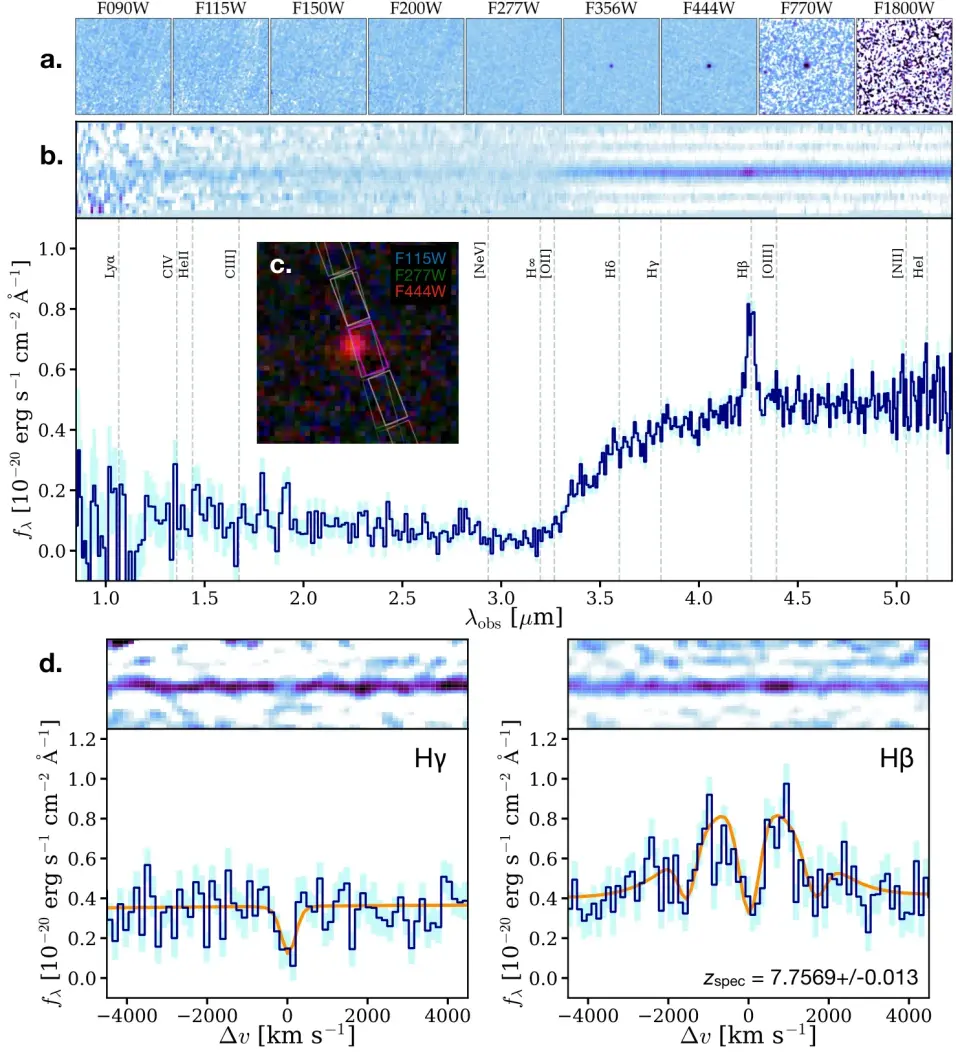
JWST images of MoM-BH*-1, a red point at z ≈ 7.7569 (about 660 million years after the Big Bang), reveal luminosity near 100 billion Suns powered not by fusion but by an accreting black hole enshrouded in a dense, nearly dust-free gas cocoon. Spectra show an extreme Balmer break and broad hydrogen lines that support a black-hole–star model, with the envelope spanning roughly 10–100 AU and gas densities ~10^11 cm^-3, column ~10^25.8 cm^-2; the black hole mass is likely ~10^6–10^7 solar masses. This finding hints at rapid black-hole growth in the early universe and helps explain the population of little red dots as buried black holes, though future observations are needed to test the cocoon scenario.
- James Webb spotted a bizarre object just 660 million years after the Big Bang that looks like an enormous star but shines with roughly 100 billion Suns' worth of energy — because hidden inside its star-like cocoon is an accreting black hole, rather than a core Space Daily
- A gas-enshrouded and gas-reddened black hole at cosmic dawn Nature
- Astronomers Discover the Existence of a Black Hole Star WIRED
- How the universe got its spots The Economist
- Astronomers Peered at the Early Universe and May Have Discovered a New Kind of Celestial Object: Black Hole Stars Smithsonian Magazine
Want the full story? Read the original reporting
Read on Space Daily