
New genomic analysis reveals two 'ghost' human ancestors, including a likely Homo heidelbergensis
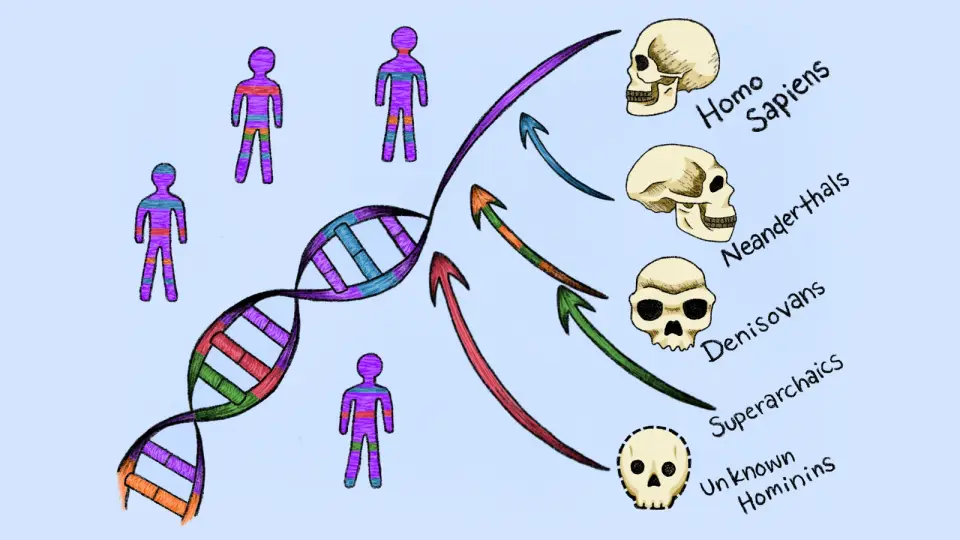
Researchers have identified two previously unknown 'ghost' lineages that contributed DNA to modern humans. Using a new computational method to build genomic family trees, scientists found that nearly 1% of the DNA in every living person comes from one of these ancestors, which likely interbred with early humans in Africa around 800,000 years ago.
Key points
- A team led by Yulin Zhang at UC Berkeley identified two 'ghost' lineages that contributed DNA to modern humans, distinct from Neanderthals and Denisovans.
- The first ghost lineage split from the main human line about 800,000 years ago and likely interbred in Africa, contributing 0.5% to 1% of DNA in all modern humans.
- The second, 'super-archaic' lineage split from humans around 1.8 million years ago and contributed DNA via interbreeding with Denisovans in Eurasia.
- The new method, which constructs genomic family trees, allows researchers to detect ancestry from species without fossil DNA evidence.
- The first ghost ancestor is hypothesized to be Homo heidelbergensis, while the second is likely Homo erectus, according to expert Chris Stringer.
Background
This discovery builds on previous findings that modern humans interbred with Neanderthals and Denisovans within the last 50,000 years. While earlier studies relied on ancient DNA from fossils, this new approach uses computational power to analyze modern human genomes, offering a more comprehensive view of our evolutionary past. It follows other recent advancements in understanding human origins, such as the identification of early scientific inquiry in the Maya civilization and ongoing debates about the role of AI in scientific research.
How outlets are covering it
Live Science and New Scientist both highlight the significance of the new computational method for identifying 'ghost' ancestry. New Scientist provides more detail on the specific researchers involved, such as Yulin Zhang and Priya Moorjani, and the potential candidates for the ghost lineages (Homo heidelbergensis and Homo erectus). The Telegraph source was inaccessible due to a security block, so its perspective could not be evaluated. The consensus among the accessible sources is that this method is a major advance in human genetics, allowing for the reconstruction of genomes from species for which no fossil DNA exists.
Why it matters
This research fundamentally changes our understanding of human evolution by revealing that our genetic heritage is more complex than previously thought. It shows that interbreeding with unknown 'ghost' populations was a significant factor in shaping the modern human genome, not just the well-known Neanderthals and Denisovans. This could lead to a more complete picture of human origins and the genetic diversity that exists today.
What to watch
Researchers may attempt to assemble the full genome of the 'ghost' ancestor using the identified DNA fragments. Further studies could explore the specific traits and adaptations that were passed down from these ancient lineages, potentially revealing how they influenced modern human biology and health.
- Scientists discover 2 new 'ghost' lineages that contributed DNA to modern humans Live Science
- New technique pinpoints human DNA inherited from 'ghost' ancestors Phys.org
- The genome of a long-extinct ancient human is hiding within us New Scientist
- Everyone alive may carry DNA from a ‘ghost lineage’ of human ancestors Yahoo
- Humans carry DNA from mysterious ancestors telegraph.co.uk
Want the full story? Read the original reporting
Read on Live Science