
Butterflies Use Wing Patterns to Create Motion Illusions That Confuse Predators
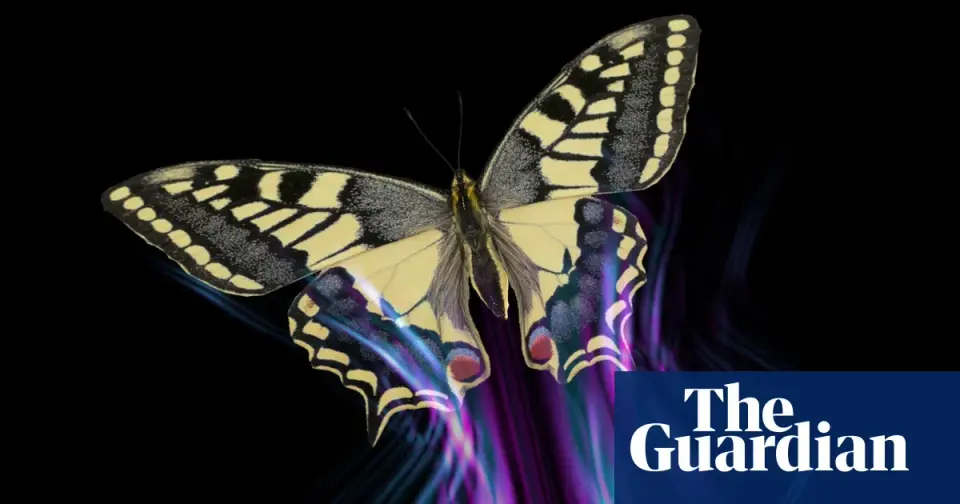
New research published in Nature reveals that butterflies evade predators not through camouflage, but by creating motion illusions. Researchers from the University of Exeter and Essex found that wing patterns, combined with flight dynamics, scramble a predator's perception of speed and direction, similar to a barber pole effect. This 'motion dazzle' causes birds to miss their targets or strike non-vital areas. The study suggests this mechanism is widespread in nature and may explain why brightly colored butterflies survive despite being visible.
Key points
- A study in Nature by researchers from the University of Exeter and Essex demonstrates that butterfly wing patterns create optical illusions that confuse predators.
- The 'motion dazzle' effect scrambles a predator's visual targeting system, causing them to misjudge the insect's speed and direction during a 'ballistic attack'.
- Swallowtail butterflies were identified as particularly effective at this defense, with their trailing tails increasing motion confusion and deflecting attacks away from vital body parts.
- The research utilized high-speed cameras, bird-vision computer models, and human volunteer tests to confirm that these illusions are widespread among European butterfly species.
- The findings suggest that motion confusion is a major evolutionary driver for wing patterns and may apply to other animals like zebras, lizards, and fish.
Background
This discovery builds on earlier research into butterfly wing structure and coloration. While previous studies, such as those by Nipam Patel at the Marine Biological Laboratory, focused on the structural coloration and genetic mechanisms (like the optix gene) that produce vibrant hues, this new study focuses on the functional role of those patterns in flight. It resolves a long-standing paradox: why brightly colored butterflies, which are not toxic, are rarely caught mid-flight, unlike moths which are common prey. The findings connect to broader discussions on disruptive camouflage in other species, such as zebras and coral reef fish, suggesting a universal principle of motion-based defense in nature.
How outlets are covering it
The Guardian and Popular Science emphasize the 'barber pole' analogy, highlighting how wing deformation during flight creates misleading motion cues. Ars Technica provides a broader context, linking this to the 'wagon-wheel effect' seen in zebras and noting that this is the first empirical evidence for motion dazzle in butterflies. All sources agree on the core finding but differ in emphasis: The Guardian focuses on the specific case of swallowtails and the 'ballistic attack' disruption, while Ars Technica highlights the evolutionary implications and the use of genetic algorithms to simulate pattern evolution. Popular Science focuses on the puzzle of visibility versus survival. No source contradicts the primary findings, but they vary in the depth of technical explanation regarding the optical mechanics.
Why it matters
This research offers a new framework for understanding animal behavior and evolution. By demonstrating that visual patterns can actively confuse predators through motion illusions, it opens a new avenue for studying anti-predator strategies in other species. It also has potential applications in fields like robotics and computer vision, where understanding how biological systems process motion could inform the design of better sensors or camouflage technologies. The study challenges the traditional view that bright coloration is solely for sexual signaling or warning, revealing a complex, multi-layered defense system.
What to watch
The researchers plan to improve their simulations to account for ventral wing patterning and more sophisticated flight dynamics. They expect these refinements to add nuance but not alter the overall conclusions. The broader implication is that scientists will likely investigate motion dazzle in other animals, such as birds, lizards, and fish, to see how widespread this defensive mechanism is. This could lead to a re-evaluation of the adaptive functions of various animal patterns in the wild.
- All of a flutter: how butterflies avoid being a predator’s lunch The Guardian
- What butterfly wings have in common with barbershop poles Ars Technica
- Butterflies use optical illusions to escape predators, reveals new research Yahoo
- Butterfly wings create dazzling optical illusions Popular Science
- Unraveling the mysterious beauty of butterfly wings Morgridge Institute for Research -
Want the full story? Read the original reporting
Read on The Guardian