
Titanosaur Eggshells in Southern Argentina Reveal Cold-Climate Incubation Strategy
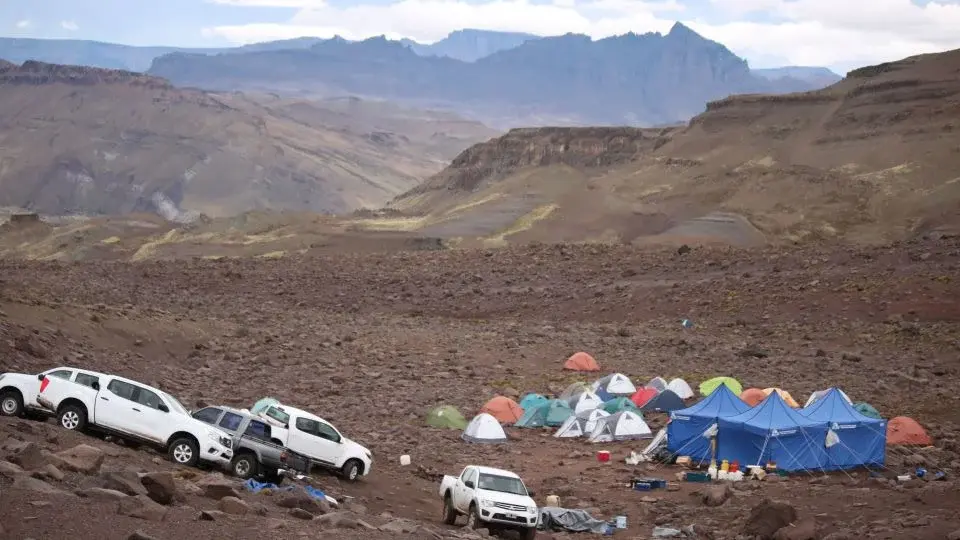
Fossilized eggshells from titanosaurs, among the largest dinosaurs, have been discovered in the Chorrillo Formation of southern Argentina, indicating these giants reproduced in cool, high-latitude environments. Published in Royal Society Open Science, the study by researchers from Japan, Argentina, and Canada shows that titanosaurs could not sit on their eggs due to their massive size. Instead, microscopic analysis of the porous eggshells suggests they used a crocodile-like strategy: burying eggs in mounds of rotting vegetation to generate heat through microbial decay, ensuring successful hatching in climates comparable to modern-day Vancouver.
Key points
- Fossilized eggshells of titanosaurs were found in the Chorrillo Formation, southern Argentina, dating to the Late Cretaceous (72-66 million years ago).
- The discovery site is the most southern known location for dinosaur eggshells, challenging previous assumptions that these giants only nested near the equator.
- Titanosaurs, weighing up to 75 tonnes, were too large to brood their volleyball-sized eggs without crushing them.
- Microscopic analysis of the eggshells revealed high porosity, indicating they were buried to prevent drying out, rather than left exposed to open air.
- Researchers propose that titanosaurs incubated eggs in mounds of decomposing vegetation, using microbial heat to warm the embryos in cool climates.
- The study was led by Kohei Tanaka of the University of Tsukuba and Darla Zelenitsky of the University of Calgary, with collaborators from Argentina.
Background
This discovery adds to a growing body of evidence regarding dinosaur adaptability in diverse climates. Recent findings, such as the neutron imaging of the T. rex 'Scotty' and the identification of new sauropodomorphs in Zimbabwe, highlight the complexity of prehistoric ecosystems. The titanosaur find specifically contrasts with earlier assumptions that large dinosaurs were restricted to warmer, equatorial regions, suggesting a broader geographic range for reproduction during the Late Cretaceous.
How outlets are covering it
CBC and The Globe and Mail emphasize the surprising latitude of the discovery, noting the cool climate comparable to modern-day New York or Vancouver. They highlight the 'crocodile strategy' of mound incubation as a key adaptation. Ratopati focuses on the logistical challenges of incubating eggs in cold regions and the lack of parental care, comparing the strategy to modern reptiles. All sources agree on the impossibility of brooding due to the dinosaurs' size, but CBC and The Globe and Mail provide more detail on the microscopic evidence (porosity) supporting the burial hypothesis, while Ratopati focuses on the broader implication of high-latitude reproduction.
Why it matters
This finding reshapes our understanding of dinosaur behavior and adaptability. It demonstrates that even the largest dinosaurs developed sophisticated reproductive strategies to survive in challenging, high-latitude environments. This challenges previous models of dinosaur distribution and highlights the flexibility of prehistoric life in response to climatic conditions, offering new insights into how species persisted before the mass extinction event.
What to watch
Researchers, including Tsu-Ruei Yang from Taiwan's National Museum of Natural Science, suggest that further studies on titanosaur nesting strategies across different regions and time periods could reveal more about their global spread. The debate on whether nesting strategies were as diverse in the earlier Cretaceous as in the Late Cretaceous may lead to new investigations into fossil sites in places like Spain, where less porous eggshells have been found, indicating different incubation methods.
- Fossilized eggs of the largest known dinosaurs have been unearthed in an unexpected place Yahoo
- How titanosaurs hatched eggs in cooler climates | CBC News CBC
- Canadian among researchers to discover dinosaurs nested farther south than previously known The Globe and Mail
- Highest Latitude Sauropod Nests Ever Found Suggest They Used Rotting Vegetation To Keep Their Babies Warm In Cold Environments IFLScience
- Titanosaurs Laid Eggs in Cold Regions, New Study Reveals Ratopati
Want the full story? Read the original reporting
Read on Yahoo